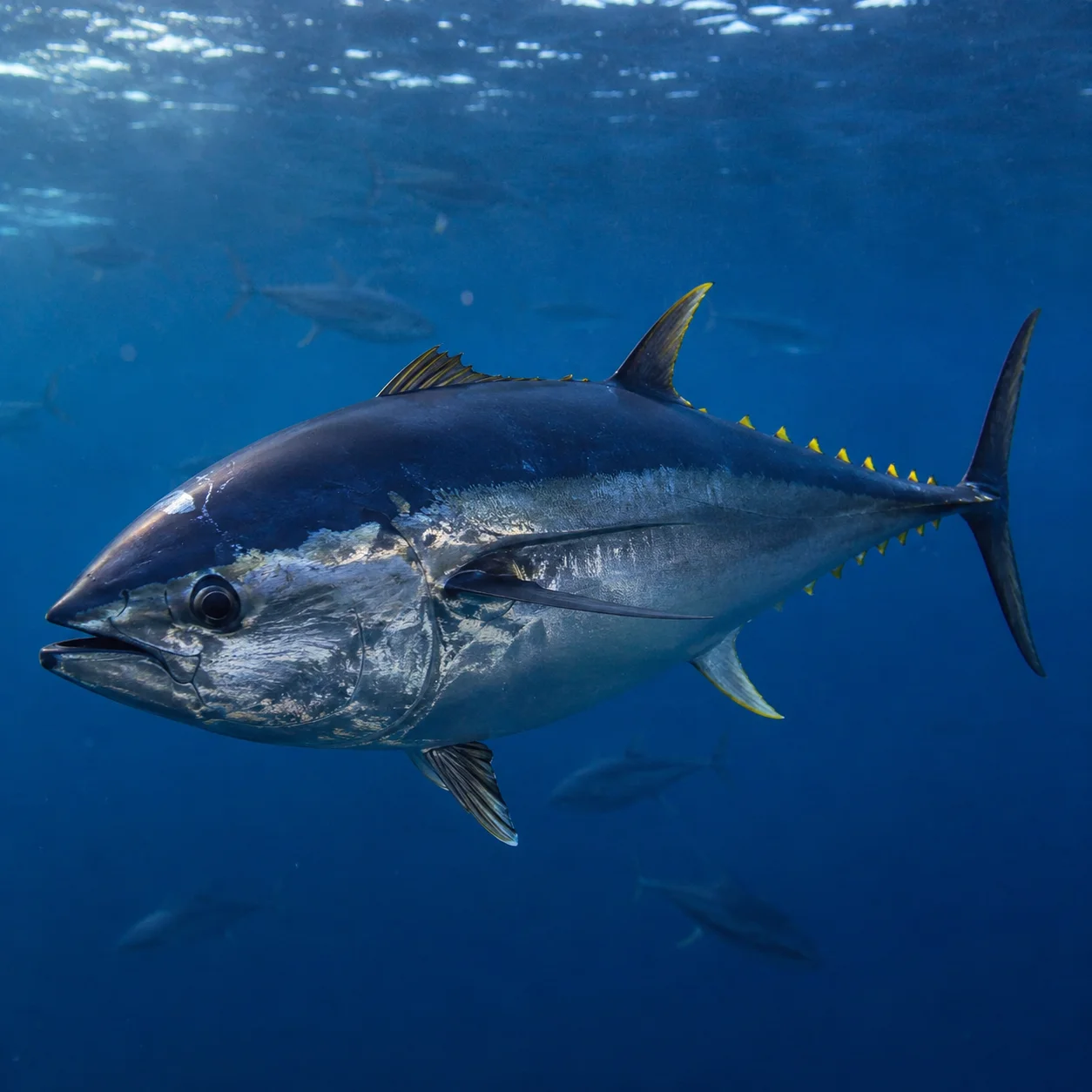
European seabass is an emblematic species of the Atlantic, sought after for its strength and its ability to occupy a wide range of habitats. It's found near rocky plateaus, drop-offs, river mouths, oyster farms and isolated structures, but its presence mainly depends on the conditions of the moment: season, water temperature, current, depth and feeding activity.
To place this species among the other fish tracked on the west coast, also check our page on Atlantic fish species.
Quick facts on European seabass
Where to look: edges, drop-offs, rocky heads, estuaries, oyster farms, rocky plateaus and sometimes wrecks.
When to look: mainly spring and autumn, with good windows early morning, in the evening or around tide changes.
Favourable temperature: often around 13 to 19 °C.
Main food: sandeels, sardines, sprats, anchovy, shrimp, crabs, marine worms and small fish.
Depth observed: from the surface to around 100 m, but often more interesting in shallow to intermediate coastal areas.
Signals to watch for: active current, foam, birds, baitfish shoals, drop-offs and changes in water colour.
European seabass in the Atlantic: a mobile, opportunistic coastal species
European seabass (Dicentrarchus labrax) is one of the emblematic species of the Atlantic coast. It's found in the eastern Atlantic, from Norway to Morocco, as well as in the Mediterranean and the Black Sea. It mainly frequents coastal areas, estuaries, lagoons and some brackish sectors.
Even though it can range down to around 100 metres deep, seabass tends to stay linked to the coastal shelf and to areas where conditions concentrate prey: current, relief, edges, river mouths, oyster farms or isolated structures.
Its appeal comes as much from its power as from its behaviour. European seabass isn't a fish fixed to one spot: its presence varies with the season, water temperature, tide, current, depth, feeding activity and biological phase. Targeting it effectively therefore requires understanding why an area becomes favourable at a given moment.
| Element | Data |
|---|---|
| Common name | European seabass |
| Scientific name | Dicentrarchus labrax |
| Family | Moronidae |
| Distribution | Eastern Atlantic, from Norway to Morocco, Mediterranean, Black Sea |
| Depth observed | Surface to around 100 m |
| Habitats frequented | Coasts, estuaries, lagoons, coastal shelf |
| Spawning period | Mainly winter / early spring |
| Species type | Mobile, opportunistic coastal predator |
What does seabass eat? Understanding its diet to locate it better
European seabass is an opportunistic predator able to adapt its diet to the seasons, weather, tides and available prey. Understanding what it eats often helps you better anticipate its movements and identify genuinely active areas.
In the Atlantic, seabass very frequently follows food concentrations: baitfish shoals, drifting crustaceans, sandeels buried in the sand or small fish trapped by the current.
For a boat angler, observing the potential food present in an area is often as important as water temperature or current strength. A drop-off holding sandeels, a rocky head swept by shrimp, or an estuary full of fry can quickly become major holding spots.
Seabass's main prey
Seabass's diet varies with its size and environment, but certain prey come up constantly:
- sandeels,
- sardines,
- sprats,
- anchovy,
- gobies,
- juvenile mullet,
- shrimp,
- crabs,
- marine worms,
- small cephalopods.
Over sandy bottoms and shallow edges, seabass often hunts sandeels and marine worms. Around rocks, oyster farms or cluttered structures, it makes more use of crabs, shrimp and small fish sheltering in the relief.
Larger seabass generally become more piscivorous with age and target more energetic prey, especially in autumn when baitfish group up.
What seabass eats by season
| Season | Dominant food | Consequence for fishing |
|---|---|---|
| Early spring | Shrimp, small fish, marine worms, sandeels | Favour warming edges, estuaries and slow retrieves |
| Spring | Sandeels, small fish, crustaceans | Fish edges, drop-offs and shallows with fine soft lures |
| Summer | Fry, sardines, anchovy, juvenile mullet, shrimp | Target current areas, visible feeding activity and early/late windows |
| Autumn | Sprats, sardines, sandeels, small mackerel, baitfish | Use bulkier lures and look for drop-offs, rocky heads and churned areas |
| Winter | Scarcer but more energetic prey | Fish more slowly, near the bottom, in deeper areas |
What seabass eats by fishing area
| Area | Dominant food | Useful reading to locate seabass |
|---|---|---|
| Estuaries | Shrimp, juvenile mullet, small fish | Interesting areas on the rising tide or when current concentrates prey |
| Beaches and sandbanks | Sandeels, marine worms | Look for gullies, sandy drop-offs and churned areas |
| Rocks and plateaus | Crabs, gobies, shrimp | Target rocky heads, current seams and foam edges |
| Oyster farms | Crustaceans and small fish | Work areas rich in hiding spots and food |
| Wrecks and structures | Baitfish shoals | Prospect the surroundings, drop-offs and concentration areas on the sounder |
Matching your lures to seabass's diet
Observing the prey present often lets you choose the size, colour and retrieve of a lure more effectively.
- With sandeels present: favour thin, fast lures,
- In crustacean-rich areas: slow the retrieve down near the bottom,
- During baitfish frenzies: use bulkier or surface lures,
- In cold water: prefer slow retrieves and more discreet soft lures.
The more conditions concentrate prey — sustained current, rising tide, foam, drop-offs or baitfish shoals picked up on the sounder — the more your chances of finding active seabass increase.
When to fish seabass in the Atlantic? The best periods by season
Seabass fishing in the Atlantic varies strongly with the season. Water temperature, spawning, prey availability, light, tides and weather all directly influence its movements. For a boat angler, understanding this seasonality helps you choose the right areas at the right time.
Seabass isn't present everywhere with the same regularity year-round. Some periods favour shallow edges, others drop-offs, rocky plateaus, estuaries or deeper areas. The goal is therefore to adapt your strategy to the fish's biological activity and prey concentration.
Early season: target areas that warm up quickly
In spring, seabass gradually return to coastal areas after winter. Their activity increases with warming water and the return of small prey to edges, estuaries and shallows.
Early in the season, shallow sectors that quickly pick up a few degrees can become very interesting. Beaches, rocky edges, oyster farms, river mouths and sheltered areas are often worth priority attention.
Fishing is generally more effective with slow to moderate retrieves, especially if the water stays cool. Thin soft lures, small shads and sandeel imitations let you prospect these feeding-recovery areas effectively.
Summer: prioritise current, oxygen and low light
In summer, seabass activity can be very strong, but it depends heavily on conditions. When the water warms up a lot, seabass often seek out oxygenated, churned or current-rich areas.
The best windows are frequently early morning, in the evening or during tide changes. Rocky points, rocky heads, current channels, oyster farms, estuaries and foam lines can concentrate active fish.
When seabass are feeding at the surface on shoals of fry or baitfish, surface lures, small minnows and lightly weighted soft lures can be very effective. During the day, it can help to fish deeper in the water column, especially over drop-offs or deeper areas.
Autumn: target big seabass on baitfish concentrations
Autumn is one of the most interesting periods for targeting big seabass in the Atlantic. Ahead of winter, fish often step up their feeding and follow concentrations of baitfish such as sprats, sardines, sandeels or small mackerel.
Current areas, rocky plateaus, drop-offs, rocky heads, wrecks and sectors exposed to swell can become very productive. Wind, foam, slight turbidity and feeding birds are all clues worth taking into account.
At this time of year, bulkier lures can be worthwhile, especially when seabass are targeting larger prey. Shads, minnows, soft lures fished on the drop and surface lures can help cover active areas effectively.
Winter: understanding lower activity and spawning
In winter, seabass activity generally drops as temperatures fall and the spawning period begins. Fish can group up in deeper or more stable areas, with more irregular feeding.
Seabass fishing should then be approached with care, particularly to respect closed seasons and protect breeding fish. Where regulations allow certain practices, slow retrieves, discreet soft lures and deeper areas are often the most consistent approach.
This period is a strong reminder of the importance of following local regulations and releasing fragile fish or those in a sensitive period. Protecting breeding fish directly determines the quality of following seasons.
| Season | Areas to prioritise | Recommended approach |
|---|---|---|
| Spring | Edges, estuaries, shallows, beaches, oyster farms | Slow retrieves, small soft lures, look for warming waters |
| Summer | Current areas, rocks, estuaries, foam, drop-offs | Fish early or late, watch for feeding activity, adapt depth |
| Autumn | Rocky plateaus, drop-offs, wrecks, churned areas, rocky heads | Target baitfish, use bulkier lures, look for big active fish |
| Winter | Deep areas, stable sectors, spawning surroundings | Follow regulations, fish slowly if allowed, protect breeding fish |
Seabass regulations: quotas, tagging and spawning
This section describes the French regulations that apply in the Bay of Biscay and the English Channel. In other countries, recreational seabass fishing is regulated differently (minimum sizes, quotas and closed seasons of its own) — always check the rules that apply where you fish before heading out.
In France, regulations vary by area. North of the 48th parallel, in the English Channel and North Sea, keeping seabass is banned from 1 February to 31 March: only rod-and-line catch-and-release is allowed. Outside this period, the quota is 3 seabass per angler per day.
South of the 48th parallel, on the French Atlantic coast, the quota is 2 seabass per angler per day. The minimum landing size is generally set at 42 cm.
Seabass kept in France must also be tagged. Tagging involves removing the lower lobe of the tail fin, without preventing the fish from being measured. On boat trips, this must be done as soon as the fish is brought aboard, unless it's kept alive before being released or released immediately.
⚠️ Important recommendation: even where keeping fish is allowed, it's still best to avoid targeting seabass during its spawning period, or just around it, to limit pressure on breeding fish. Always check the regulations in force in your country before every trip.
How to fish seabass from a boat? Techniques and reading areas
Boat fishing for seabass gives access to areas that are often hard to reach from shore: drop-offs, rocky plateaus, rocky heads, oyster farms, wrecks, estuaries, current seams or exposed edges. To succeed, the goal isn't just to travel far, but to understand why an area can concentrate active seabass at a given moment.
A good seabass spot generally brings together several elements: current, relief, food and an ambush zone. The boat lets you prospect these sectors precisely, adjust your drift and follow how activity changes over the tide.
Reading an area before fishing
Before casting, it's worth observing the whole area: current direction, foam, feeding birds, eddies, changes in water colour, a drop-off visible on the sounder or a concentration of baitfish.
Seabass often use relief to save energy and intercept drifting prey. A rocky head, a sandy step, a plateau edge or a wreck can create a current break favourable to hunting.
Using the drift to prospect effectively
From a boat, drift is one of the most important levers for seabass fishing. A well-placed drift lets you present the lure naturally in the current, over a drop-off, along an edge or over a baitfish zone.
It's often better to make several precise passes rather than staying too long over an inactive area. If bites keep happening in the same spot, note the alignment, depth, drift speed and tide stage.
Fishing drop-offs, rocks and plateaus
Drop-offs and rocky plateaus are major areas for seabass. They concentrate prey, accelerate the current and offer natural ambush spots. The fish may hold on top of the plateau, on the slope or at the foot of the drop-off depending on tide and light.
Soft lures, shads, minnows and surface lures can all be used depending on depth and activity. When seabass are feeding high in the water column, a faster or surface approach can be productive. If activity is low, a slower presentation near the bottom often becomes more consistent.
Making the most of feeding activity and signs
Visible feeding is a valuable clue, but shouldn't be approached carelessly. It's best to avoid running the motor straight into the shoal. A gradual approach, cutting speed at a distance, keeps you discreet and prolongs the activity.
Birds, eddies, small fish jumping, changes in surface texture or concentrations on the sounder can all signal active seabass. Even when the feeding stops, the fish sometimes stay in the area, lower in the water column.
Matching technique to depth
| Depth | Typical areas | Recommended approach |
|---|---|---|
| 0 to 3 m | Edges, shallows, foam, beaches | Surface lures, shallow-diving minnows, lightly weighted soft lures |
| 3 to 10 m | Plateaus, oyster farms, rocky heads | Shads, soft lures, minnows, straight or light lift-and-drop retrieves |
| 10 to 25 m | Drop-offs, channels, wrecks, current areas | Weighted soft lures, lift-and-drop, light vertical, controlled drifts |
| More than 25 m | Deep areas, seasonal groupings, wrecks | Slow fishing near the bottom, vertical, sounder-based prospecting |
Choosing your lures for boat seabass fishing
Lure choice depends on depth, current, prey size and fish activity. From a boat, it's useful to have several lure profiles to cover different water layers.
- Surface lures: useful on feeding fish, shallows and shallow areas,
- Minnows: effective for prospecting edges, plateaus and current areas,
- Thin soft lures: suited to sandeels, clear water and wary fish,
- Bulkier shads: interesting in autumn or for big fish,
- Heavier rigs: useful for fishing drop-offs, channels and deep areas.
The stronger the current or the greater the depth, the more you need to adjust the weight to keep contact with the lure without restricting its swimming action. Conversely, over shallow edges, a light, natural presentation is often more effective.
Linking boat fishing to FishPredict data
FishPredict helps identify moments when several factors become favourable at the same time: water temperature, tide, current, depth, sea conditions and area configuration. For seabass, this combination is essential because the fish moves around a lot depending on feeding activity.
An area can be excellent for an hour and then become much less productive once the current drops, the tide changes or prey scatters. Cross-referencing on-the-water observation with forecasts therefore helps you choose your window better and focus your drifts on the most promising sectors.
Where does European seabass live and why are some areas more favourable?
European seabass is strongly linked to the coastline, but it isn't distributed evenly along it. It mainly seeks sectors where several conditions combine: water circulation, available food, relief, shelter and hunting opportunities. So it's less about looking for "the coast" broadly than about areas where the environment creates genuine activity.
It's found on rocky points, rocky heads, coastal plateaus, river mouths, estuaries, oyster farms, wrecks and current edges. Young seabass often use estuaries, lagoons and sheltered areas as growth zones, while older fish tend to frequent more open sectors, structured by relief, tide and the presence of prey.
What makes the difference isn't just the type of area, but how it behaves at a given moment. An area becomes favourable when it concentrates prey, speeds up or channels the current, creates a drop-off, an edge or a change in bottom type. Two nearby sectors can therefore be very different: one may be uniform and not very active, while the other offers relief, a current seam, a sand-rock edge or a food source.
Oyster farms deserve special attention. They structure the environment, shelter many prey and create interesting water circulation for seabass. Depending on the sector, you can find small green crabs there, which seabass may feed on. On some farms, the falling tide can make the area more active.
Wrecks also play an important role. They create relief, break the current, often concentrate life and offer seabass holding, sheltering and hunting spots. In more uniform areas, they can become genuine points of attraction.
In the Atlantic, this logic is found mainly around lively sectors: straits, island edges, estuary surroundings, oyster farms, wrecks, tide-swept coastal plateaus, drop-offs and areas where underwater relief clearly organises fish movement.
| Type of area | Interest for seabass |
|---|---|
| Rocky point | Accelerated current, feeding, edges |
| Rocky head / shallow bank | Prey concentration, break in relief |
| Estuary / river mouth | Food, water circulation, young fish |
| Oyster farm | Structure, food, small green crabs, water circulation |
| Wreck | Relief, shelter, concentration of life, hunting spot |
| Coastal plateau | Movement and feeding area |
| Current edge | Mobile marker, feeding activity |
| Drop-off / slope break | Holding, circulation, ambush spot |
Under what conditions does European seabass become more interesting to target?
European seabass becomes more interesting to target when several factors combine. A favourable temperature isn't enough on its own. The sector also needs to offer water movement, relief, available prey and the ability to concentrate activity. It's this combination that turns an ordinary area into a favourable sector.
Water temperature plays an important role. Seabass tolerates a wide thermal range, roughly 8 to 24 °C, but often becomes more active when the water sits around 13 to 19 °C. These figures help explain why spring and autumn often offer more consistent conditions than periods of marked cold or intense heat.
Salinity can also give clues, especially near estuaries, river mouths and areas influenced by freshwater input. Seabass remains a marine species, but tolerates slightly less salty water well. Values around 27 to 35 PSU often correspond to coastal, estuarine or brackish waters compatible with its presence.
The richness of the environment is another useful signal. Chlorophyll-a gives an indication of plankton activity, and therefore of an area's ability to support a food chain. Moderate values, around 0.4 to 2.5 mg/m³, can indicate active sectors without being excessively loaded.
Underwater relief remains decisive. Even though seabass can be found from the surface down to around 100 metres, it's often more interesting to target it in shallow to intermediate coastal areas: drop-offs, shallow banks, slope breaks, current edges, rocky plateaus or isolated structures.
In the end, the best areas are rarely defined by a single criterion. They bring together several signals at once: suitable temperature, active current, marked relief, available food and consistent depth. It's these combinations that make an area genuinely favourable.
| Factor | Useful guideline for seabass |
|---|---|
| Tolerated temperature | 8 to 24 °C |
| Often favourable temperature | 13 to 19 °C |
| Favourable salinity | 27 to 35 PSU |
| Interesting chlorophyll-a | 0.4 to 2.5 mg/m³ |
| Depth observed | 0 to 100 m |
What lures to use for seabass depending on depth, prey and activity?
Choosing a lure for seabass rarely comes down to a single criterion. You need to cross-reference depth, current strength, the size of prey present and the fish's level of activity. A seabass feeding at the surface on baitfish isn't fished the same way as one holding near the bottom over a drop-off.
From a boat, it's useful to have several lure families to cover different water layers: surface, mid-water, near the bottom or deeper areas. The goal is to present a lure that matches the available food and the likely position of the seabass.
Choosing your lure by depth
| Depth | Suitable lures | Use |
|---|---|---|
| 0 to 3 m | Surface lures, shallow-diving minnows, light soft lures | Edges, shallows, beaches, foam, visible feeding |
| 3 to 10 m | Minnows, shads, thin soft lures, light blades | Rocky plateaus, oyster farms, rocky heads, current seams |
| 10 to 25 m | Weighted shads, jigs, vibration blades, soft lures fished on the drop | Drop-offs, channels, wrecks, areas of sustained current |
| More than 25 m | Jigs, heavy shads, vertical rigs | Deep areas, wrecks, fish close to the bottom |
Choosing your lure by prey present
| Dominant prey | Recommended lure | Approach |
|---|---|---|
| Sandeels | Thin lures, slugs, small elongated shads, slim minnows | Straight retrieve, light lift-and-drop or fast retrieve near the sandy bottom |
| Sardines, sprats, anchovy | Minnows, shads, surface lures, casting jigs | Prospecting feeding fish, current edges and baitfish shoals |
| Shrimp and crabs | Small soft lures, creature baits, discreet shads | Slow retrieve near the bottom, around rocks, oyster farms or estuaries |
| Juvenile mullet | Minnows, bulkier soft lures, stickbaits | Prospecting edges, river mouths and calm areas near the current |
Matching your lure to seabass activity
When seabass are active, it's often possible to use more visible, faster or bulkier lures. Surface lures, minnows and shads then let you cover an area quickly and trigger reaction strikes.
When activity is lower, a more discreet approach is often preferable. Thin soft lures, slow retrieves, lighter weights or a presentation close to the bottom can better suit wary or less mobile fish.
- Seabass feeding: surface lure, minnow, shad or casting jig,
- Seabass near the bottom: weighted shad, jig or soft lure on the drop,
- Wary seabass: thin lure, slow retrieve, natural colour,
- Active seabass in autumn: bulkier lure to imitate baitfish.
The right lure is therefore the one that matches the behaviour of the moment. FishPredict helps identify the windows where current, temperature, depth and feeding activity become favourable, but on-the-water observation remains essential to fine-tune size, weight and retrieve.
FAQ on European seabass
Where does European seabass live?
European seabass mainly lives along coasts, in estuaries, around river mouths, over rocky areas, coastal plateaus, some oyster farms and, depending on the time of year, around more open sectors such as plateau edges or certain wrecks.
When should you fish for seabass in the Atlantic?
Seabass can be present year-round, but spring and autumn often offer the most interesting periods. Early spring can also be favourable in some sectors, especially after spawning, which remains a sensitive phase to respect.
At what depth is European seabass found?
Seabass can range from the surface down to around 100 metres. In practice, it's often targeted at shallow to intermediate depths, especially where relief creates an edge, a drop-off or a shallow bank.
Does European seabass frequent estuaries and oyster farms?
Yes. Estuaries are an important habitat for the species, especially for young fish. Oyster farms can also be interesting, as they structure the environment, concentrate life and shelter prey such as small green crabs.
Does European seabass hold on wrecks?
Yes, wrecks can be very good sectors. They create relief, break the current and often concentrate life, making them credible spots for movement, holding or hunting.
What lures should you use to fish European seabass?
Minnows remain a safe choice, especially for covering water and prospecting edges. Vibration blades often give excellent results, while jigs are very useful for reaching fish closer to the bottom.