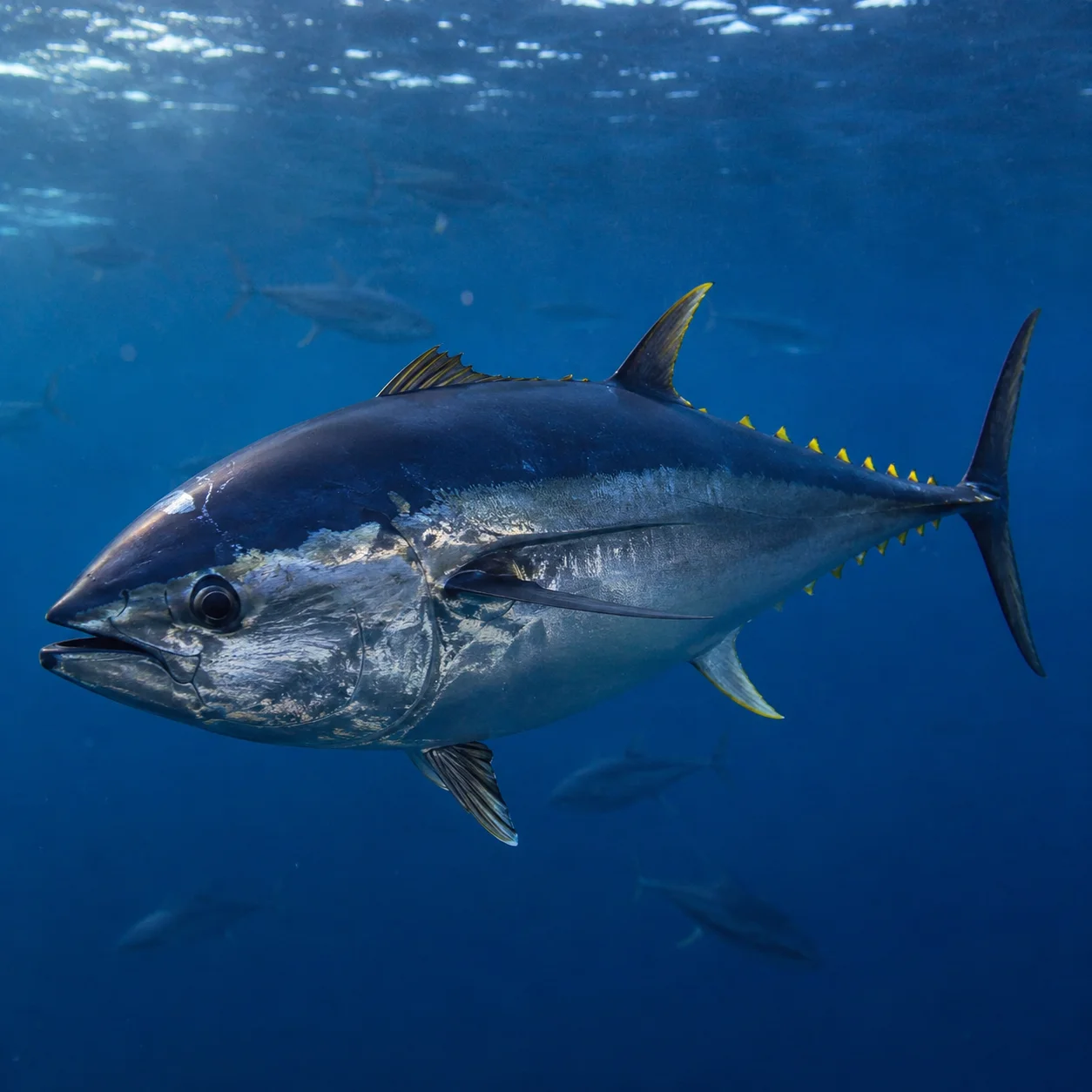
Pollack is an emblematic fish of rocky Atlantic coasts. More discreet at the surface than other predators, it's mainly read through depth, bottom structure and the stability of conditions. To target it effectively, you need to focus on rocky areas, drop-offs, ledges, hard plateaus and well-placed wrecks. Ifremer describes it as a species present near the coast down to 150-200 m, often over rocky bottoms or close to wrecks. To explore other fish species, also check our page on Atlantic fish species.
Quick facts on pollack
Where to look: wrecks, rocky drop-offs, ledges, hard plateaus, rocky heads and current areas.
When to look: often from late winter to early autumn, with good windows around spring and on some wrecks in summer.
Usual depth: 20 to 150 m, with fishing often interesting around relief and wrecks.
Favourable temperature: often between 6 and 16 °C, with a consistent window around 9 to 14 °C.
Main food: small fish, sandeels, pouting, cephalopods, shrimp and crustaceans.
Signals to watch for: sounder activity, marked relief, wrecks, drop-offs, current, baitfish and takes on the drop.
Pollack in the Atlantic: a species tied to the bottom
Pollack is a typical fish of rocky Atlantic coasts. It's found in sectors where bottom relief plays an important role in organising marine life. Its presence depends less on visible surface activity than on the consistency of the underwater environment.
It frequents rocky areas, drop-offs, ledges, irregular plateaus, marked relief and wrecks capable of offering it a stable habitat. It's not depth alone that matters, but how that depth is organised around a useful bottom. Ifremer explicitly mentions rocky bottoms and wrecks among the habitats particularly sought by the species.
For pollack, reading presence relies mainly on habitat. This factor is dominant, ahead of surface signals. This fits well with the species' ecology: a bottom-dwelling fish, tied to structured spots, more sensitive to the quality of the sector than to a simple passing water movement.
| Element | Data |
|---|---|
| Common name | Pollack |
| Scientific name | Pollachius pollachius |
| Species type | Bottom-dwelling fish tied to hard bottoms and relief |
| Usual depth | 20 to 150 m |
| Maximum depth mentioned | Up to 150 to 200 m near the coast |
| Habitats frequented | Rocky areas, drop-offs, ledges, hard plateaus, wrecks |
| Spawning period | Spring |
| General presence | Most of the year |
| Often favourable period | Spring to early autumn |
What does pollack eat? Understanding its prey to locate it better
Pollack is an opportunistic predator that feeds mainly on small fish, cephalopods and crustaceans. Understanding its diet helps you better read the areas where it can hold: wrecks, rocky drop-offs, ledges, hard plateaus or sectors where current concentrates prey.
This logic matters for boat fishing. Pollack doesn't sit on a structure just because it exists: it mainly uses it when relief, current and the presence of food create a genuine hunting opportunity.
Pollack's main prey
- sandeels,
- pouting,
- small baitfish,
- cephalopods such as small squid,
- shrimp and other crustaceans.
Over hard bottoms and marked relief, pollack can take advantage of small fish sheltering around rocks, wrecks or ledges. Over sandy or sandy-rocky areas close to current, sandeels and other elongated fish can become important prey.
Matching your search to the prey present
| Dominant prey | Likely area | Useful reading |
|---|---|---|
| Sandeels | Sandy bottoms, plateau edges, sandy-rocky areas | Watch for drop-offs, current and areas where sandeels group up |
| Pouting and small fish | Wrecks, rocks, drop-offs, deep structures | Prospect around relief and concentrations visible on the sounder |
| Cephalopods | Mixed bottoms, plateaus, areas close to the bottom | Favour slow retrieves close to the substrate |
| Shrimp and crustaceans | Hard bottoms, rocky areas, moderate relief | Look for sectors rich in life near the bottom |
This diet explains why the best pollack areas are often structured sectors. A wreck, a drop-off or a ledge become genuinely interesting when they concentrate current, relief and available prey all at once.
How to fish pollack from a boat? Wrecks, drop-offs and sounder
Pollack fishing is very often practised from a boat, since this fish frequents structured sectors sometimes far from shore: wrecks, rocky drop-offs, ledges, hard plateaus, rocky heads or areas with marked current. The boat lets you work these relief features precisely and adjust your drift to the fish's position.
Pollack is strongly tied to relief. It can hold close to the bottom, around a wreck or a drop-off, but can also lift off into the water column to follow baitfish. This mobility is why sounder observation is often essential.
Reading areas on the sounder
The sounder lets you identify relief, wrecks, baitfish shoals and echoes close to the bottom. In some areas, pollack appear lifted off the relief, while in others they stay very close to the structure.
A ledge, a drop-off or a wreck become especially interesting when they concentrate current and food. Even a small variation in relief can create a holding zone favourable to hunting.
Fishing wrecks and drop-offs
Wrecks are major sectors for pollack. They create relief, concentrate life and often shelter small fish. Rocky drop-offs and ledges play a similar role by structuring current and prey movement.
In these areas, precision of your passes matters. A slightly off-line drift can be enough to miss active fish. It's therefore often worth repeating several passes while adjusting the boat's course.
Managing drift and depth
Pollack can be targeted at varying depths, often between 20 and 150 m depending on sector and season. The greater the depth or current, the more important it becomes to adjust your weight to keep contact with the lure.
A drift that's too fast can pull the lure out of the useful zone. Conversely, a good drift lets you present the lure naturally along a drop-off, a wreck or a ledge.
The most interesting sectors
| Area | Why it can hold pollack | Recommended approach |
|---|---|---|
| Wrecks | Relief, concentration of life, shelter for prey | Precise passes around the structure and careful sounder reading |
| Rocky drop-offs | Current, marked relief, ambush zones | Prospect different heights in the water column |
| Ledges | Depth break and prey passage | Controlled drifts and fishing close to the bottom |
| Hard plateaus | Presence of baitfish and moderate relief | Active sounder search and slow prospecting |
| Rocky heads | Accelerated current and feeding activity | Precise presentations and repeated passes |
FishPredict helps spot the moments when temperature, current, depth and feeding activity become consistent for pollack. For this species, so closely tied to relief and baitfish, cross-referencing on-the-water observation with environmental data often helps you choose the right drifts and windows.
What techniques should you use to fish pollack?
Pollack can be fished in several ways depending on its position in the water column, depth, current and its level of activity. It can stay close to the bottom, hold around a piece of relief, or rise clearly to follow prey. The right technique is therefore the one that keeps you in the layer where the fish are active.
Slow lift-and-drop fishing
Slow lift-and-drop is well suited when fish are holding near the bottom, over a ledge, a wreck or a drop-off. It involves lifting the lure off the bottom gradually, then controlling its fall to maintain a natural presentation.
This approach lets you cover an area while staying close to the relief. It's especially interesting with soft lures, shads or sandeel imitations.
Vertical jigging
Vertical jigging is useful when fish are clearly located on the sounder. It lets you present the lure right under the boat, in the correct water layer, with good control despite depth or current.
When fishing vertically, adjust the weight to keep contact without restricting the lure's swimming action. A simple, regular, precise action is often more effective than an overly aggressive movement.
Jig fishing
Jigs can be very effective on pollack, especially in deep water, over wrecks, drop-offs or current areas. They sink fast, let you prospect several water layers, and sometimes trigger takes on the drop.
Pollack can follow a lure for several metres before striking. So don't neglect pauses, controlled drops and gradual retrieves.
The elevator technique
The elevator technique involves lifting the lure up through the water column, then letting it fall back in a controlled way. It can be useful when fish lift off the bottom or follow prey in mid-water.
This method can trigger fish that are following the lure, especially when the sounder shows echoes suspended above a wreck, a drop-off or a baitfish shoal.
| Technique | When to use it | Benefit |
|---|---|---|
| Slow lift-and-drop | Fish near the bottom, ledges, wrecks | Natural, precise presentation |
| Vertical | Fish located on the sounder | Control of depth and the lure |
| Jig | Deep areas, current, active fish | Fast drop and effective prospecting |
| Elevator | Fish lifted off or following | Lets you work the whole water column |
What lures should you use to fish pollack?
Lure choice for pollack mainly depends on depth, current, prey size and the fish's position in the water column. Over a wreck, drop-off or ledge, choose a lure that can sink correctly while keeping a natural swimming action.
Soft lures are often very effective, especially shads, slugs and sandeel imitations. Jigs are also interesting when depth or current require a fast drop, or when fish respond better to a more vertical action.
Choosing your lure by situation
| Situation | Suitable lures | Recommended approach |
|---|---|---|
| Fish close to the bottom | Shads, weighted soft lures, jigs | Slow retrieve, lift-and-drop or vertical |
| Fish lifted off | Slugs, shads, jigs, elongated soft lures | Work the water column and control drops |
| Sandeels present | Sandeel imitations, thin slugs, elongated lures | Straight retrieve, slow lift-and-drop or elevator |
| Wrecks and drop-offs | Shads, jigs, large soft lures | Precise passes around the relief |
| Marked current | Jigs, heavier jig heads, compact lures | Adjust weight to stay in the right water layer |
Adjusting size and weight
For pollack, lures of 12 to 18 cm already cover many situations. On big fish, around wrecks or when prey are larger, lures of 20 cm or more can also be worthwhile.
Weight should be chosen based on depth, current and drift speed. The goal is to keep contact with the lure without pinning it down. Too light a rig passes over the useful zone, while too heavy a rig can make the presentation less natural.
Colours and visibility
Natural colours are often consistent when the water is clear or fish are wary. More visible tones, such as pink, orange, yellow or chartreuse, can also give good results when the water is coloured, light is low, or fish respond better to a more marked signal.
As is often the case, there's no absolute rule. The best colour is the one that matches the conditions of the moment, the prey present and the fish's reaction observed during the session.
Pollack regulations: closed season, quotas, minimum size and tagging
This section describes the French regulations. In France, recreational pollack (Pollachius pollachius) fishing is regulated in the English Channel and Atlantic. A closed season applies from 1 January to 30 April: no pollack may be caught or kept during this period.
From 1 May to 31 December, the quota depends on the fishing area. North of the 48th parallel, catches are limited to 3 pollack per angler per day. South of the 48th parallel, the limit is 2 pollack per angler per day.
The minimum landing size for pollack is set at 42 cm. Pollack kept must also be tagged. Tagging involves removing the lower lobe of the tail fin, without preventing the fish from being measured.
In other countries, recreational fishing regulations (minimum sizes, quotas, possible closed seasons) vary — always check the rules in force where you fish before heading out.
⚠️ Important: during closed seasons, it's better to avoid deliberately targeting pollack rather than practising ineffective catch-and-release. When brought up from deep water, pollack can suffer pressure-related trauma, particularly affecting the swim bladder. In that case, a released fish may have very little chance of survival.
Where does pollack live?
Pollack mainly frequents rocky areas and hard bottoms. It holds where relief lets it move around, hold station and hunt effectively.
The most interesting sectors are often made up of rocky heads, moderate drop-offs, clean ledges, rocky plateaus and wrecks. These structures create consistent spots for a species strongly tied to the architecture of the seabed. Ifremer states that pollack is present near the coast down to 150-200 m, mostly over rocky bottoms or close to wrecks.
Wrecks, in particular, are often very interesting areas for pollack. They concentrate relief, offer shelter, create a clear break in the underwater landscape and favour the presence of prey. For a fish that favours structured sectors, they often represent very credible holding spots.
Not all hard bottoms are equal, though. A featureless mineral area with no real break in relief can look promising but remain secondary. Conversely, a well-placed wreck, a discreet ledge, a marked slope or an isolated rock can become excellent spots. For this species, bottom structure often matters more than the general appearance of the area.
| Type of area | Interest for pollack |
|---|---|
| Rocky head | Structured spot, circulation, hunting |
| Drop-off | Depth variation, holding and movement |
| Clean ledge | Break in relief, credible spot |
| Rocky plateau | Consistent hard bottom, regular presence zone |
| Wreck | Relief, shelter, concentration of prey |
| Bathymetric slope | Bottom organisation and fish movement |
At what depth should you look for pollack?
Pollack can be found between 20 and 150 metres. This range is wide, but that doesn't mean every depth is equally good. Ifremer reviews indicate a presence down to 150 to 200 metres close to the coast.
A depth around 40.3 metres often serves as a useful benchmark, especially when paired with a hard bottom and consistent relief. Between 30 and 80 metres, the reading often becomes especially interesting over well-structured rocky sectors.
The largest individuals tend to favour deeper, more pronounced habitats. Younger fish, on the other hand, may hold in shallower areas, sometimes closer to shore. Here too, depth only has value when paired with a bottom capable of offering a genuine holding spot.
| Depth guideline | Useful reading |
|---|---|
| 20 to 150 m | Usual search range |
| 30 to 80 m | Range often interesting over structured bottom |
| 40.3 m | Often relevant benchmark in the model |
| 150 to 200 m | Maximum depth mentioned near the coast |
When does pollack become more interesting to target?
Pollack can be found across a large part of the year, but not every period is equal. Its presence often becomes more readable from spring to early autumn, when temperature stays consistent over the hard bottoms and relief it frequents.
Ifremer also states that pollack spawns in spring.
In practice, recreational pollack fishing is closed from 1 January to 30 April in French waters in ICES areas 7 and 8. Area 7 broadly covers the English Channel, the Celtic Sea and waters west of Brittany up to the north of the Bay of Biscay. Area 8 corresponds to the Bay of Biscay, up to the Atlantic waters of northern Spain. Outside the closed season, the limit is two fish per angler per day in French waters.
The most favourable period to target pollack therefore mainly starts after the season reopens, when thermal conditions become interesting again over rocky areas, ledges, drop-offs and wrecks.
| Period | General trend |
|---|---|
| Winter | Presence possible but often less consistent reading depending on sector |
| Spring | More readable resurgence after the closed season, key period for the species |
| Summer | Regular presence over favourable sectors |
| Early autumn | Often still an interesting period |
| 1 January to 30 April | Closed season for recreational fishing in ICES areas 7 and 8 (France) |
What conditions favour pollack fishing?
To understand where pollack is most likely to hold, you first need to look at habitat. Bottom, slope, structure and depth carry more weight here than surface phenomena.
A rocky sector with a ledge, a drop-off, a rocky head, a wreck or a bathymetric slope is more credible than a large, uniform bottom. Bathymetric slope and the depth-temperature pairing play a particularly important role in reading this species.
Temperature then acts as a major filter. Pollack lives within a favourable range of between 6 and 16 °C, with a more consistent window between 9 and 14 °C. When this temperature settles over a well-structured hard bottom, the area's interest increases significantly.
The most consistent salinity sits between 32 and 36 PSU. Other variables can fine-tune the reading without becoming central. Chlorophyll levels between 0.2 and 1.5 and zooplankton between 1 and 8, according to the model indicator, can accompany favourable sectors when they stay compatible with a stable habitat.
Conversely, pollack shows a low affinity for fronts. It's therefore read much less through horizontal surface breaks than through bottom logic. This is an important difference from more mobile species, or those more directly tied to visible signals.
| Factor | Useful guideline for pollack |
|---|---|
| Favourable temperature | 6 to 16 °C |
| Consistent thermal window | 9 to 14 °C |
| Favourable salinity | 32 to 36 PSU |
| Favourable chlorophyll | 0.2 to 1.5 |
| Favourable zooplankton | 1 to 8 |
| Sensitivity to fronts | Low |
| Main signal | Bottom quality, relief, stability |
FAQ on pollack
Where does pollack live?
Pollack mainly frequents rocky areas, drop-offs, ledges, hard plateaus and wrecks. It holds in sectors where bottom relief strongly structures the space and offers consistent spots for movement, holding and hunting.
When should you target pollack in the Atlantic?
Pollack can be found across much of the year, but its presence often becomes more readable from spring to early autumn. This period is generally more consistent when temperature stays favourable over the hard bottoms and relief it frequents.
At what depth is pollack found?
Pollack can be targeted between 20 and 150 metres deep. In practice, certain depths around 40 metres often become especially interesting when paired with a well-structured hard bottom, a ledge or a drop-off.
Does pollack frequent rocky areas and wrecks?
Yes. Pollack is strongly tied to rocky bottoms, underwater relief and wrecks. These structures create stable spots, offer shelter and often concentrate prey, making them credible sectors for this species.
Does pollack hold on wrecks?
Yes, wrecks can be excellent sectors for pollack. They bring relief, break up bottom uniformity and often provide very consistent holding spots for a fish strongly tied to environmental structure.
What conditions make pollack more interesting to target?
Pollack often becomes more interesting to target when several factors combine: a hard bottom, a ledge, a drop-off, consistent depth, favourable temperature and good sector stability. For this species, bottom logic generally matters more than visible surface signals.
What's the difference between pollack and European seabass?
Pollack and European seabass aren't read the same way. Seabass tends to be more tied to coastal dynamics, edges and visible signals, while pollack is mainly understood through depth, slope, bottom structure and the stability of conditions.
Is pollack fishing closed?
Yes, in France. In recreational fishing, in French waters in ICES areas 7 and 8, no pollack may be caught or kept between 1 January and 30 April. Outside the closed season, the limit is set at two fish per angler per day. In other countries, check your local regulations.