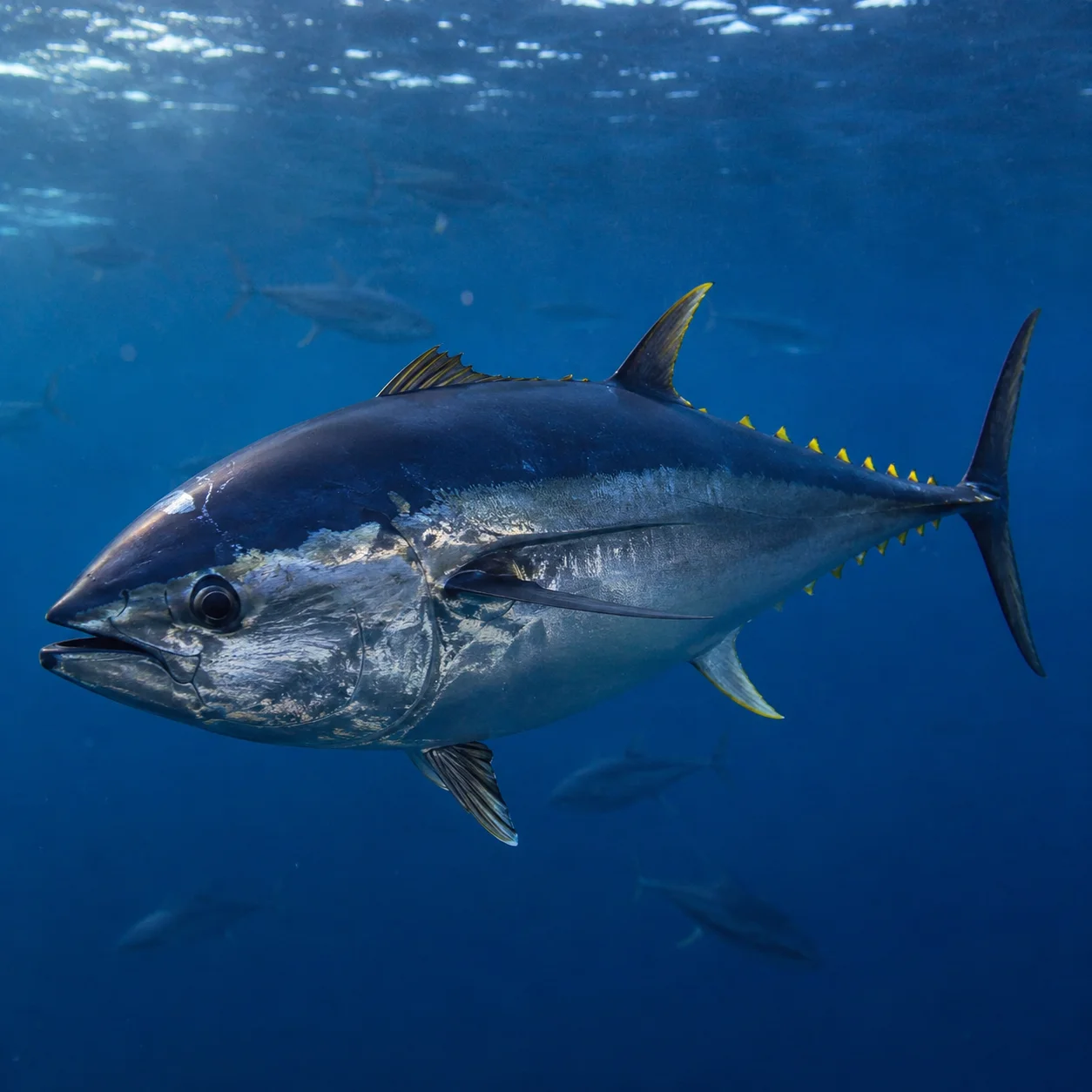
The Atlantic coast and the Bay of Biscay are home to many fish species with very different behaviours. Seabass, pollack, meagre, bluefin tuna, horse mackerel, cuttlefish and squid don't occupy the same areas and don't respond to the same conditions. Water temperature, currents, depth, seabed type, food availability and season all directly influence their presence. Understanding these parameters better helps you know which species to target in the Atlantic and focus your search more effectively. This page brings together the main species tracked on FishPredict and gives access to their detailed guides.
Which fish species are found on the Atlantic coast?
Atlantic coastal waters host a wide diversity of species, present depending on the area, the season and the conditions of the moment. Some frequent rocky areas close to shore, sectors with stronger current, underwater relief, oyster farms or certain wrecks, while others range over plateaus, drop-offs, sandy bottoms or deeper zones.
This diversity explains why there is no single answer to the question of which species to target in the Atlantic. Depending on the time of year, the water temperature, the currents, the depth and the type of bottom, some species will be more consistently worth searching for than others.
Understanding which fish species are found in the Atlantic therefore helps you prepare a trip better, adapt your reading of the environment and target the most relevant sectors depending on the conditions encountered.
Discover the detailed guide for each species
Below you'll find the main species tracked by FishPredict. Each guide details the species' behaviour, habitats, seasonality and the areas where its presence is likely to be most consistent depending on conditions.
What factors influence the presence of species?
Fish are never distributed at random. Each species frequents areas that match its needs, its behaviour and the conditions of the moment. Some seek out relief, edges or current zones, while others hold over more open bottoms, at different depths or in more specific sectors.
Water temperature plays a central role, since each species has a comfort range that influences its activity, the depth it holds at and its movements. Currents matter too, because they structure the environment, move water masses and can make certain sectors more favourable at certain times. In some cases, temperature fronts or salinity fronts mark particularly interesting transition zones, often linked to increased biological activity.
Depth and seabed type also have a direct influence. Depending on the species, fish may frequent rocky, sandy or muddy areas, as well as drop-offs, plateaus, edges, estuaries, oyster farms or certain wrecks. How consistent a sector is therefore depends as much on its structure as on its position within the environment.
More technical indicators can also refine this reading. Chlorophyll-a, used as an indicator of phytoplankton, gives information about surface biological production. Phytoplankton and zooplankton sit at the base of the marine food web, which explains why their presence or abundance can help you better understand the distribution of prey, and then of fish. These parameters aren't enough on their own, but they become very useful when cross-referenced with temperature, salinity, currents and bottom structure.
Finally, the season changes the distribution of species throughout the year. Migration, spawning, movements, warming water, changing salinity and the organisation of water masses all alter fish presence depending on the time of year. This is exactly the logic FishPredict aims to capture: compiling, for each species, the most useful parameters to better understand when and where its presence becomes more consistent.