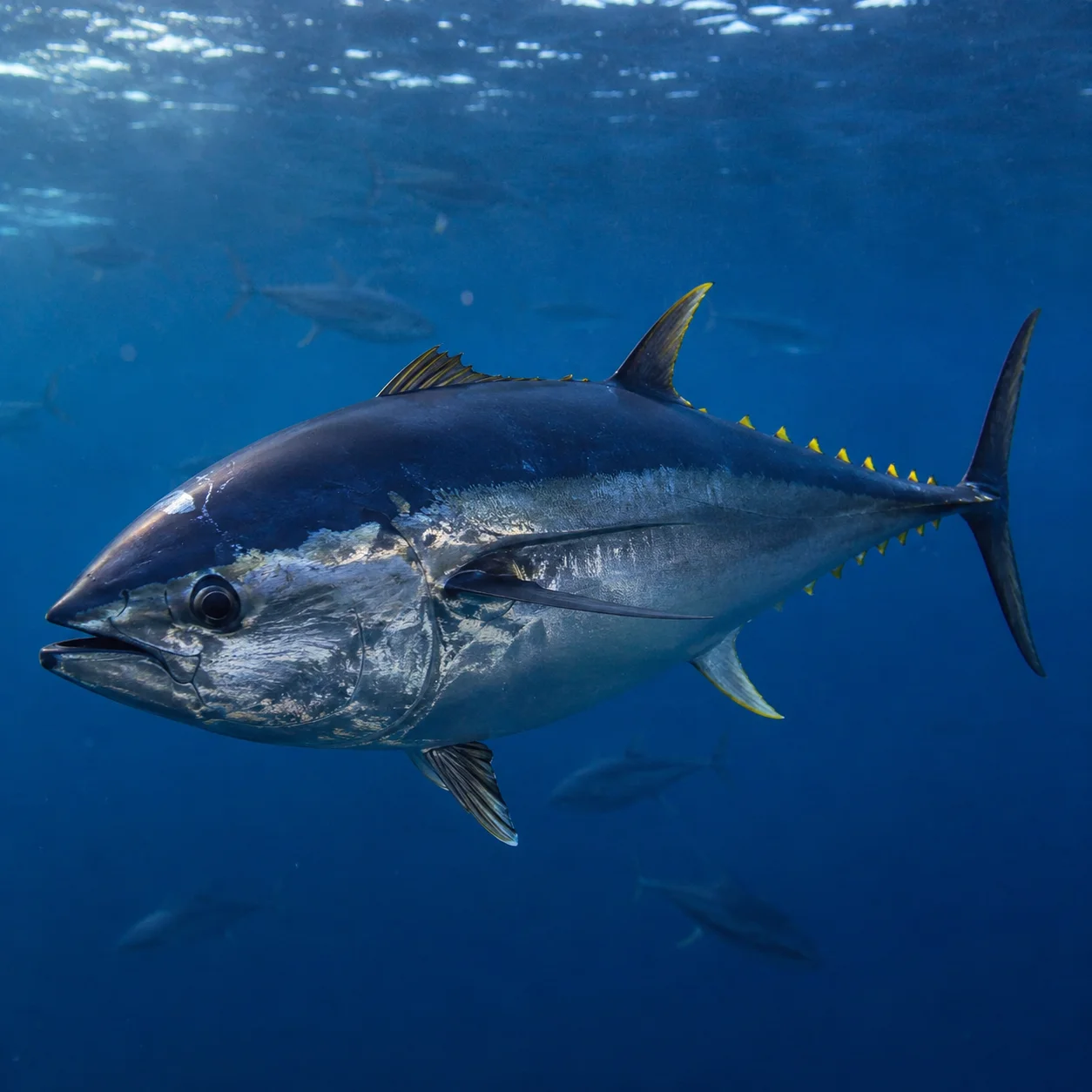
A pelagic, mobile and often gregarious fish, horse mackerel isn't as easy to pin down as you might think. In the Atlantic, its presence depends on feeding habits, water movement and certain transition zones between coast and open sea. To discover other Atlantic fish and access our species-by-species pages, also check our page on Atlantic fish species.
Quick facts on horse mackerel
Where to look: baitfish shoals, harbours, breakwaters, jetties, points, current areas, wrecks, feeding frenzies and active sectors in open water.
When to look: mainly during the warm season, with good windows early morning, evening, at night or when small fish concentrate.
Useful depth: often mid-water, from the surface to intermediate layers, depending on shoal position and observed activity.
Main food: zooplankton, larvae, small crustaceans, small fish, fry and pelagic prey.
Effective techniques: light tackle, small soft lures, casting jigs, small minnows, sabiki rigs and fast or jerky retrieves.
Signals to watch for: birds, small feeding frenzies, baitfish, echoes on the sounder, surface disturbance and closely spaced bites.
Horse mackerel, a mobile fish widely present in the Atlantic
Atlantic horse mackerel (Trachurus trachurus) is a pelagic fish of the Carangidae family, widely distributed in the eastern Atlantic. It's recognised by its elongated body, silvery flanks and clearly marked lateral line. But for the angler, that's not what matters most: horse mackerel stands out mainly for its mobility, its groupings and its ability to quickly occupy a favourable sector.
Unlike species more tied to the bottom, horse mackerel is read primarily through what's happening in the water mass. It frequents areas where food concentrates, where currents structure activity, and where fish circulate according to a logic set by the environment.
When it's well established in an area, this often reveals a favourable balance between food resources, water circulation and biological activity.
| Element | Data |
|---|---|
| Common name | Horse mackerel |
| Scientific name | Trachurus trachurus |
| Family | Carangidae |
| Species type | Gregarious pelagic fish |
| Distribution | Eastern Atlantic, North Sea, Mediterranean, Black Sea |
| Depth observed | 0 to 300 m |
| Tolerated temperature | 8 to 20 °C |
| Favourable temperature | 10.5 to 16.5 °C |
| Favourable salinity | 30 to 36 PSU (marine to slightly coastal waters) |
What does horse mackerel eat? Understanding its prey to locate it better
Horse mackerel is a gregarious pelagic fish, often found in shoals. To locate it, you mainly need to understand where its prey concentrates: zooplankton, small crustaceans, larvae, fry and small baitfish.
This diet explains why horse mackerel can appear quickly in an area, then vanish just as fast. When a shoal of prey groups up near a harbour, a breakwater, a point, a current area or in open water, horse mackerel can follow and trigger very visible feeding frenzies.
Horse mackerel's main prey
- zooplankton,
- larvae,
- small crustaceans,
- fry,
- small baitfish,
- small pelagic prey.
Matching your search to the prey present
| Dominant prey | Likely area | Useful reading for fishing |
|---|---|---|
| Zooplankton and larvae | Open water, calm areas, harbours, sheltered sectors | Watch for tight shoals and closely spaced bites |
| Small crustaceans | Harbour areas, breakwaters, edges, lit sectors | Fish light with small lures or fine rigs |
| Fry and small fish | Feeding frenzies, points, currents, harbour entrances, open water | Watch birds, surface disturbance and baitfish |
| Small pelagic prey | Intermediate layers, current areas, echoes on the sounder | Adjust fishing depth to the shoal's position |
Horse mackerel is therefore rarely a solitary fish. When an area concentrates small prey, several fish can hold together and bites can come thick and fast. Conversely, if food disperses, the shoal can move within minutes.
How to fish horse mackerel with light tackle?
Horse mackerel is particularly well suited to light and ultra-light tackle fishing. Its average size, shoaling behaviour and fast strikes let you use fine, sensitive, enjoyable tackle, both from shore and from a boat.
This approach lets you cast small lures a good distance, feel bites better and keep a natural presentation. On active fish, strikes can be numerous and come in quick succession.
Using light tackle
A light or ultra-light rod is more than enough to target horse mackerel. Power ratings around 3-10 g or 5-15 g already cover many situations.
A small reel loaded with fine braid or discreet mono helps with sensitivity and casting distance. This finesse becomes especially useful when fish are wary or feeding on very small prey.
Prospecting the water layers
Horse mackerel doesn't always stay at the same level. It can feed just under the surface, hold mid-water, or follow a shoal of prey deeper down.
So you need to vary your prospecting depth: letting the lure sink more, speeding up the retrieve, slowing down or working with small pulls can be enough to find the right water layer.
Bites are often fast and grouped
Horse mackerel frequently moves in shoals. When you find an active group, bites can come very quickly for a few minutes.
Conversely, a spot can seem empty then suddenly turn active if a shoal of baitfish arrives in the area. This mobility is why you need to stay on the move and multiply your passes.
Interesting areas for light tackle fishing
| Area | Why it can be interesting | Recommended approach |
|---|---|---|
| Harbours and breakwaters | Small prey present and lit areas | Small lures and fast retrieves |
| Points and currents | Food concentration | Active prospecting and cast-and-retrieve |
| Beaches and edges | Possible passage of shoals | Mobile search and light tackle |
| Open water | Baitfish shoals and pelagic activity | Vary depths and follow feeding frenzies |
| Lit areas at night | Concentration of larvae and small fish | Small soft lures and steady retrieves |
For horse mackerel, mobility and observation remain essential. Birds, small feeding frenzies, surface disturbance or activity visible on the sounder often let you quickly locate active shoals.
What lures should you use to fish horse mackerel?
Horse mackerel generally responds better to small lures that can imitate the prey it's hunting: fry, small baitfish, larvae or small crustaceans. Presentation finesse often matters more than lure size.
Small soft lures, casting jigs, light vibration blades and small minnows are particularly effective. When fish are active in a shoal, bites can be very fast, especially if the lure passes through the right water layer.
Choosing your lure by situation
| Situation | Suitable lures | Recommended approach |
|---|---|---|
| Small surface feeding frenzies | Small casting jigs, mini minnows, small slugs | Fast retrieve and long casts |
| Fish mid-water | Small shads, slugs, micro-jigs | Vary depths and speeds |
| Deeper fish | Micro-jigs, vibration blades, denser lures | Let sink before retrieving |
| Harbours and lit areas | Small soft lures, sabiki, mini shads | Discreet, steady retrieves |
| Difficult fish | Very thin lures, small natural formats | Light presentation and slower retrieve |
Adjusting size and weight
Lures of 3 to 7 cm already cover many situations for horse mackerel. Small formats tend to be the most consistent, especially when fish are targeting very small prey.
Weight mainly depends on casting distance, current and depth. In light fishing, a few grams are often enough. On deeper fish or in the presence of current, though, it can help to use micro-jigs or denser lures to quickly reach the right water layer.
Fast retrieves and changes of pace
Horse mackerel often responds to jerky retrieves: fast recovery, small pulls, short pauses or sudden bursts of speed.
When fish follow without striking, a change of speed or a controlled drop can be enough to trigger the bite. On some active shoals, strikes even happen during the lure's fall.
Don't overlook sabiki rigs
Sabiki rigs remain very effective on horse mackerel, especially when fish are feeding on very small prey. They let you present several fine imitations across different water layers.
This approach is especially useful from a boat, in harbours or around lit areas at night, when fish are grouped in tight shoals.
How to fish horse mackerel from a boat?
Boat fishing for horse mackerel lets you follow baitfish shoals, small feeding frenzies and fish movements in open water. Unlike species more tied to the bottom, horse mackerel is often sought in the water column, around active areas and food concentrations.
The boat mainly lets you stay mobile. Shoals can move quickly depending on current, light, prey presence or bird activity. A productive area can go quiet within minutes, then become active again shortly after.
Watching feeding frenzies and birds
Birds are often very good indicators for horse mackerel. When they circle or dive over small feeding frenzies, this can reveal the presence of baitfish being chased by active shoals.
Even discreet feeding activity, with a few splashes or small surface ripples, deserves quick prospecting before the shoal moves on.
Using the sounder to follow shoals
The sounder lets you spot balls of baitfish and echoes suspended in the water column. Horse mackerel can move at different depths depending on light, current or the position of prey.
It's therefore useful to vary fishing depth rather than staying only near the surface. A simple difference of a few metres can be enough to find active fish.
Staying mobile and multiplying passes
Horse mackerel is rarely completely static. Even once a shoal is located, it can move quickly around an active area.
From a boat, it's often better to make several short drifts and reposition rather than insisting for a long time over an area that's gone quiet.
Interesting areas from a boat
| Area | Why it can be interesting | Recommended approach |
|---|---|---|
| Surface feeding frenzies | Presence of baitfish | Fast casts and mobile prospecting |
| Current areas | Food concentration | Follow shoal movements |
| Harbour entrances | Small prey and local activity | Light tackle and fast retrieves |
| Open water | Shoals suspended in the water column | Use the sounder and vary depths |
| Lit areas at night | Concentration of larvae and small fish | Sabiki, micro-jigs and small soft lures |
FishPredict helps spot the moments when temperature, current, feeding activity and prey concentration become consistent. For horse mackerel, this dynamic reading of shoals and active areas is often more important than a simple fixed spot.
Where does horse mackerel live in the Atlantic?
Horse mackerel frequents coastal areas as much as plateaus and certain more open zones. But it often becomes more interesting to target in intermediate spaces: bay exits, plateau edges, transitions between coastal water and open sea.
So it shouldn't only be sought near the bottom or the shore, but in areas where the sea isn't uniform.
| Type of sector | Interest |
|---|---|
| Coast-to-offshore transition | Water circulation and shoal movement |
| Tidal front | Meeting zone between water masses → food concentration |
| Current edge | Grouping and feeding activity |
| Convergence zone | Accumulation of plankton and prey |
What makes an area interesting
Horse mackerel becomes interesting when several elements combine:
active water + food + edge + circulation space.
The most telling areas are often:
- tidal fronts (areas where tidal currents create a water separation),
- current edges,
- mixing zones.
Horse mackerel regulations in the Atlantic: minimum size and protecting breeding fish
Horse mackerel regulations: minimum size and resource management
This section describes the French regulations. In France, recreational horse mackerel (Trachurus trachurus) fishing remains permitted on the Atlantic coast, particularly in ICES areas 7 and 8.
Horse mackerel isn't currently subject to a specific quota for French recreational anglers. The minimum landing size generally applied is 15 cm.
As with other marine species subject to tagging in France, fish kept must have the lower lobe of the tail fin removed, without preventing the fish from being measured.
In other countries, recreational fishing regulations (minimum sizes, possible quotas) vary — always check the rules in force where you fish before heading out.
⚠️ Important: horse mackerel can sometimes group into very dense shoals and produce very fast-paced fishing. Even without a specific quota, it's still best to keep only the fish intended for reasonable consumption.
When fish need to be released, single hooks and fine rigs generally help limit injury and make unhooking easier.
FAQ on horse mackerel
Is horse mackerel a pelagic fish?
Yes, it lives in open water and moves in shoals.
Does it live in shoals?
Yes, this is a core feature of the species.
Where should you look for it?
On transitions, fronts and current areas.
Is it present year-round?
Yes, but its position depends on conditions.
Why is it linked to fronts?
Because these areas concentrate food and structure water circulation.