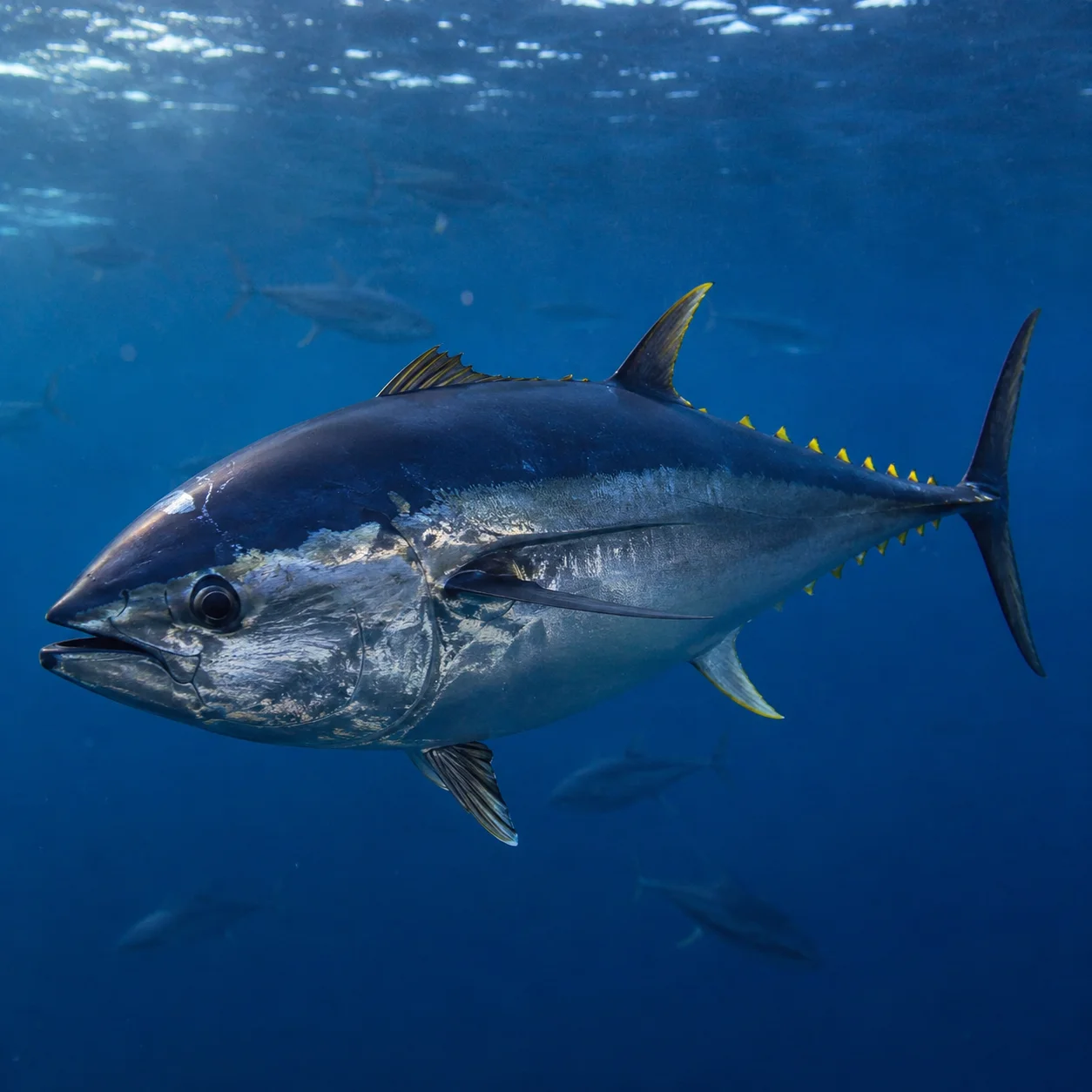
Meagre is one of the great migratory fish of the Atlantic coast. Powerful and highly mobile, it moves closer to shore as the season progresses and particularly frequents sectors influenced by estuaries and river mouths. Its presence often depends on specific conditions: water temperature, currents, depth and prey availability. To place it among the other species tracked on the Atlantic coast, you can also check our page on Atlantic fish species.
Quick facts on meagre
Where to look: estuaries, river mouths, sandy-rocky plateaus, wrecks, convergence zones and active sectors of the Bay of Biscay.
When to look: mainly April to September, with a very interesting period from July to September after spawning.
Favourable temperature: around 13 to 23 °C, with a window often favourable between 15 and 20 °C.
Main food: sardines, anchovy, sprats, horse mackerel, small fish, cuttlefish and other cephalopods.
Useful depth: from the surface to around 80 m, with fishing often interesting over plateaus, drop-offs and wrecks.
Signals to watch for: sounder activity, presence of baitfish, marked current, drop-offs, wrecks and underwater relief.
Meagre, a large migratory fish well established in the Atlantic
Meagre (Argyrosomus regius) is one of the largest coastal fish of the European Atlantic. It can exceed 1.80 m and reach more than 60 kg, making it a species particularly sought after by sport anglers. But its size and power don't sum up its behaviour.
Meagre is above all a migratory, highly mobile fish. In spring, adults move closer to the coast and to estuaries, particularly to spawn. This spawning period partly explains why certain sectors become more favourable as the water warms up.
Its presence isn't therefore regular everywhere or all year round. It mainly depends on the season, water temperature, proximity to river mouths, depth and feeding activity. This is why targeting meagre is less about aiming for a fixed spot than about understanding when an area becomes interesting.
| Element | Data |
|---|---|
| Common name | Meagre |
| Scientific name | Argyrosomus regius |
| Family | Sciaenidae |
| Maximum size | More than 1.80 m |
| Maximum weight cited | More than 60 kg |
| Species type | Bentho-pelagic coastal fish |
| Useful depth | Surface to around 80 m |
| Distribution | Eastern Atlantic, Mediterranean, French Atlantic coast |
| Notable habitats | Estuaries, river mouths, coastal areas, coastal shelf |
| Most favourable period | April to September |
What does meagre eat? Understanding its prey to locate it better
Meagre is a large coastal predator that often follows food concentrations. To locate it effectively, you need to focus on areas where baitfish and bottom prey group up: estuaries, river mouths, sandy-rocky plateaus, drop-offs, wrecks or sectors churned by current.
Its diet varies with the fish's size, the season and the environment frequented. Young meagre eat more small prey, while older individuals often target more energetic prey.
Meagre's main prey
- sardines,
- anchovy,
- sprats,
- horse mackerel,
- small mullet,
- cephalopods such as cuttlefish and squid,
- crustaceans depending on the sector.
The presence of baitfish is an important signal. When a shoal of sardines, anchovy or sprats concentrates in a current area or near a piece of relief, meagre can hold there to feed.
Matching your search to the food present
| Dominant prey | Likely area | Useful reading |
|---|---|---|
| Sardines, anchovy, sprats | River mouths, current areas, plateaus, open water | Watch for birds, the sounder and baitfish concentrations |
| Horse mackerel and small fish | Drop-offs, wrecks, deep sectors | Prospect around relief and depth breaks |
| Cuttlefish, squid and cephalopods | Sandy-rocky bottoms, plateaus, areas close to the bottom | Favour slow retrieves close to the substrate |
| Crustaceans | Estuaries, sandy-muddy areas, mixed bottoms | Look for sectors rich in life near the bottom |
This feeding logic explains why meagre is often associated with transition zones: estuary mouths, channels, drop-offs, wrecks or current-swept plateaus. It's not just depth that matters, but an area's ability to concentrate prey at the right moment.
How to fish meagre from a boat? Sounder, drift and vertical fishing
Meagre fishing is often practised from a boat, as this species frequents areas sometimes far from shore: river mouths, channels, drop-offs, sandy-rocky plateaus, wrecks or deep sectors of the Bay of Biscay. The boat lets you follow baitfish concentrations, read relief on the sounder and fish precisely near the bottom.
To succeed, the goal isn't just to find great depth. Above all, you need to spot sectors where several elements combine: current, relief, food, a bottom break and fish visible on the sounder.
Using the sounder to spot activity
The sounder is a very useful tool for meagre fishing. It lets you identify baitfish shoals, echoes close to the bottom, drop-offs, wrecks and changes in structure. An area may look uniform at the surface but reveal significant activity near the bottom on the sounder.
Meagre can hold under shoals of small fish or near relief that channels the current. When echoes are close to the bottom, adjust weight and retrieve to stay in the right water layer.
Fishing near the bottom, vertically
Vertical fishing is particularly well suited when meagre have been located on the sounder. It involves presenting a lure right under the boat, as close as possible to where the fish are holding. This approach keeps good contact with the lure, especially in current or at significant depths.
Retrieves should often stay simple: lift the lure slightly off the bottom, follow the drift, then re-establish contact. A retrieve that's too fast can sometimes be less effective than a slow, steady presentation.
Managing the boat's drift well
From a boat, drift directly affects how the lure is presented. If the boat drifts too fast, the lure rises in the water column and passes over the fish. If the drift is poorly oriented, it can miss the drop-off, the wreck or the baitfish shoal entirely.
It's therefore useful to make several passes over the area, watching drift speed, current direction, depth and the position of echoes on the sounder. Bites can occur over a very precise stretch of the pass.
Priority areas to prospect
| Area | Why it can hold meagre | Recommended approach |
|---|---|---|
| River mouths and estuaries | Food concentration, current, baitfish | Sounder prospecting, fishing near the bottom or mid-water depending on echoes |
| Drop-offs and channels | Depth break, prey passage, hunting spots | Precise drifts, vertical or weighted soft lure |
| Sandy-rocky plateaus | Mixed bottoms, cephalopods, small fish | Slow retrieves near the bottom |
| Wrecks and structures | Relief, concentration of life, shelter for prey | Repeated passes around the structure, careful sounder reading |
| Deep areas | Possible holding of large individuals, stable conditions | Heavier lures, vertical, regular bottom contact |
FishPredict helps cross-reference these observations with the conditions of the moment: temperature, depth, current, tide, salinity and potential feeding activity. For meagre, this combination is essential, since an area can become very interesting when prey concentrate near the bottom or around a piece of relief.
Once fish have been located on the sounder or in an active area, lure choice and presentation become essential to stay in the right water layer and imitate the prey present.
What lures should you use to fish meagre?
Meagre is often fished with lures able to sink quickly and stay effective near the bottom. Lure choice mainly depends on depth, current, prey size and fish activity observed on the sounder. Jigs are often very successful, especially when you need to fish fast, get down to the right water layer or prospect deep areas.
Bulky soft lures are often well suited, as they can imitate baitfish, cephalopods or prey close to the bottom. On big meagre, soft lures of 20 to 25 cm aren't excessive, especially when they imitate good-sized prey such as mullet, horse mackerel, sardines or cephalopods. In deep or current-swept areas, weight needs to be sufficient to maintain contact without making the presentation too abrupt. Some highly visible colours, such as orange or fluorescent yellow, sometimes give good results, particularly in coloured water or low light, without this being an absolute rule.
When the bottom is deep, or when drift and current are strong, jig heads of 100 to 150 g may be needed to ensure precise lure placement. The goal is to stay in the right water layer, as close as possible to fish spotted on the sounder, without losing control of the presentation.
Choosing your lure by situation
| Situation | Suitable lures | Recommended approach |
|---|---|---|
| Fish close to the bottom | Weighted shads, large soft lures, jigs | Slow retrieve, regular bottom contact |
| Marked current | Weighted soft lures, jigs, heavy rigs | Adjust weight to stay in the right water layer |
| Baitfish present | Shads, slugs, casting jigs, elongated soft lures | Match the size of prey observed on the sounder |
| Less active fish | Discreet soft lures, slow retrieves, vertical fishing | Limit fast retrieves and stay close to the substrate |
| Wrecks or drop-offs | Shads, jigs, soft lures fished on the drop | Multiply precise passes around the relief |
Keeping the right lure placement
The key point is to maintain a precise presentation. A lure that's too light drifts out of the useful zone, while a rig that's too heavy can lose naturalness. So you need to find the right balance to keep contact, follow the drift and stay close to fish spotted on the sounder.
When fishing vertically, you need to feel the bottom, control the drop and reposition the lure in the right water layer. Over a wreck, a drop-off or a channel, this precision can make the difference between an effective pass and a lure that passes over the active zone.
Favour simple retrieves
Meagre doesn't always respond to fast retrieves. When it's close to the bottom, a slow, steady retrieve close to the substrate can be more effective. It can be enough to lift the lure slightly, control the drop, then re-establish contact with the bottom.
When fish are more active or positioned under a shoal of baitfish, a wider retrieve can help trigger a strike. Watching the sounder remains the best way to adjust your presentation.
Where does meagre live on the Atlantic coast?
Meagre is generally described as a bentho-pelagic species. This means it moves both in relation to the water column and to proximity to the bottom, without staying strictly glued to the substrate. This intermediate position fits well with its behaviour. Meagre uses coastal volumes, moderate relief, passage zones and sectors where conditions become favourable to it.
On the Atlantic coast, some environments matter more than others. River mouths, estuaries, summer coastal edges and certain sectors of the Bay of Biscay play a central role in understanding the species. These are spaces where salinity variation, available food, water circulation and movement corridors all combine.
Meagre seems to respond particularly well to these transition zones. Where the sea meets water coming from rivers and estuaries, where currents structure the space and prey concentrate, its presence often becomes more likely. This is why estuaries and large river mouths hold an important place in understanding the species.
Spawning further reinforces this logic. On the French Atlantic coast, the Gironde estuary holds a major place in the meagre's cycle: it's an important area for the species' spawning in the Bay of Biscay. A good meagre sector isn't necessarily an isolated or spectacular spot. It's often an area where several parameters combine: favourable temperature, water circulation, biological activity, suitable depth and proximity to a transition zone.
| Type of sector | Potential interest for meagre |
|---|---|
| Estuary | Salinity transition, food, spawning |
| River mouth | Passage zone, water mixing, trophic activity |
| Summer coastal edge | Water circulation, favourable temperature |
| Coastal plateau | Movement, feeding, seasonal holding |
| Moderate relief / gentle drop-off | Structuring of space, passage |
| Convergence zone / edge | Prey concentration and better readability |
What is the best season for meagre in the Atlantic?
Meagre is a species with marked seasonality. In the Atlantic, the most favourable period mainly runs from April to September, with rising interest in spring, then activity often more readable in summer depending on the sector.
Water temperature plays an important role. Meagre generally becomes more interesting to target as coastal waters warm up, particularly around 13 to 23 °C, with a range often favourable between 15 and 20 °C.
This seasonality should also be read with caution: spring and early summer correspond to a sensitive period linked to spawning. Groups of large individuals deserve particular attention and reasonable harvesting.
| Season | General reading |
|---|---|
| Winter | More discreet activity, lower coastal readability |
| Spring | Gradual return to certain coastal and estuarine sectors |
| Early summer | Key period, but sensitive due to breeding groups |
| Summer | Activity often more readable near prey, drop-offs and sounder zones |
| Early autumn | End of favourable window depending on sector and conditions |
Migration, spawning and croaking: understanding the meagre's cycle
Meagre is a migratory species whose presence varies strongly over the year. In the Atlantic, it's particularly associated with the Bay of Biscay and the Gironde estuary, which plays a major role in its biological cycle.
In spring and early summer, adults move closer to certain areas favourable to spawning. This period corresponds to significant groupings, often linked to water temperature, salinity, current and bottom configuration.
A species tied to large estuaries
Meagre frequents coastal areas, estuaries and river mouths, but isn't distributed the same way everywhere. Sectors able to concentrate prey and offer stable conditions often become more favourable.
Younger individuals make more use of estuarine and coastal areas, while larger fish can move to more open sectors: drop-offs, plateaus, channels, wrecks or deep areas.
Meagre spawning
Meagre spawning mainly takes place in spring and early summer. During this period, adults can form significant concentrations in certain sectors. These groupings make the species more vulnerable to fishing pressure.
It's therefore important to stay cautious during sensitive periods, especially when large individuals are grouped together. Big meagre play an important role in renewing the species.
Why is meagre said to "croak"?
Meagre is known for producing low-frequency sounds, often described as croaking or grunting. These sounds are linked to its social and reproductive behaviour. They can be noticeable under certain conditions, especially when fish are grouped together.
This trait partly explains the fascination around the species. Meagre isn't just a large coastal predator: it's also a fish with very distinctive behaviour, whose movements and groupings follow a seasonal logic.
What this cycle means for fishing
| Period | Likely behaviour | Useful reading |
|---|---|---|
| Spring | Gradual return towards coastal and estuarine areas | Watch temperature, salinity, current and early groupings |
| Early summer | Spawning period, possible concentrations | Stay cautious with large fish and respect regulations |
| Summer | More marked feeding activity depending on sector | Target baitfish, drop-offs, river mouths and sounder zones |
| Late summer / early autumn | Gradual dispersal and movement to other areas | Adapt prospecting to conditions and prey concentrations |
Understanding this cycle helps you interpret FishPredict data more effectively. A favourable meagre area isn't just a deep zone or one close to an estuary: it's a sector where season, temperature, current, food and the species' biological phase combine at the right moment.
At what depth is meagre found?
Meagre can be observed from the surface down to around 80 metres, but it remains especially interesting to target at shallow to moderate coastal depths. In practice, many active areas sit in much shallower sectors, particularly around river mouths, drop-offs, channels, plateaus and areas close to estuaries.
Depth alone isn't enough to explain its presence. An area becomes especially interesting when it combines relief, current, available food and activity close to the bottom.
| Guideline | Interest for meagre |
|---|---|
| 0 to 10 m | Coastal edges, transition zones, river mouths and active shallow sectors |
| 10 to 20 m | Depths often interesting for fishing plateaus, drop-offs and channels |
| 20 to 80 m | Deeper areas, wrecks, relief and sectors frequented depending on season |
What makes an area truly interesting for meagre
Meagre becomes especially interesting to target when several factors combine. The first is temperature: as long as the water stays too cold, the species is often less present or harder to locate. In the Atlantic, conditions generally become more favourable around 13 to 23 °C, with a range often more interesting between 15 and 20 °C. The second factor is the structure of the environment: river mouth, estuary, edge, convergence zone or transition between different waters. The third is depth, particularly when it stays suited to a coastal reading, often down to around 80 m, with fishing sectors often interesting at much shallower depths.
FishPredict also takes into account complementary indicators such as salinity, chlorophyll-a and zooplankton, which help fine-tune the reading of favourable areas depending on species, season and sector. For meagre, this can correspond to a salinity around 24 to 33 PSU, to chlorophyll-a levels around 1 to 6 mg/m³, and to a zooplankton index around 3 to 15 in the model.
In practice, an area favourable to meagre often brings together several elements: sufficiently warm water, an active coastal sector, a river mouth or estuary, suitable depth and available food.
| Factor | Useful guideline for meagre |
|---|---|
| Water temperature | Around 13 to 23 °C, with a range often more favourable between 15 and 20 °C |
| Salinity | Around 24 to 33 PSU |
| Depth | Down to around 80 m, with fishing sectors often interesting well below that |
| Chlorophyll-a | Around 1 to 6 mg/m³ |
| Zooplankton | Model index around 3 to 15 |
| Estuary / river mouth | Concentrates transitions, prey and movements |
Meagre regulations in the Atlantic: minimum size, tagging and protecting breeding fish
Check before every trip
This section describes the French regulations. In France, the minimum landing size for meagre (Argyrosomus regius) is set at 50 cm in the North Sea, English Channel and Atlantic. Fish kept must also be tagged, in line with the rules applicable to French recreational sea fishing.
Tagging involves removing the lower lobe of the tail fin, without preventing the fish from being measured. On boat trips, this must be done as soon as the fish is brought aboard, unless it's kept alive before being released or released immediately.
In other countries, recreational fishing regulations (minimum sizes, quotas) vary — always check the rules in force where you fish before heading out.
⚠️ Important recommendation: even though the legal minimum size in France is 50 cm, it's better to release meagre under 80 cm. This benchmark lets more fish reach spawning age, particularly females, whose sexual maturity generally comes later than that of males.
FAQ on meagre
Is meagre an Atlantic fish?
Yes. Meagre (Argyrosomus regius) is well established on the French Atlantic coast, particularly in the Bay of Biscay.
How big can meagre grow?
Meagre can exceed 1.80 m and reach more than 60 kg.
Does meagre live in estuaries?
Yes. Estuaries play an important role in its ecology, particularly in relation to certain coastal-presence and spawning phases.
In what season does meagre become most interesting to target?
Mainly from spring to summer, and often into early autumn depending on the sector, with a particularly consistent period from April to September.
At what depth is meagre found?
In a consistent coastal reading, mainly from the surface to around 80 metres, with interest often concentrated at moderate depths.
Why are river mouths important for meagre?
Because they concentrate transitions in salinity, temperature, food and water circulation that are particularly favourable to a mobile species like meagre.