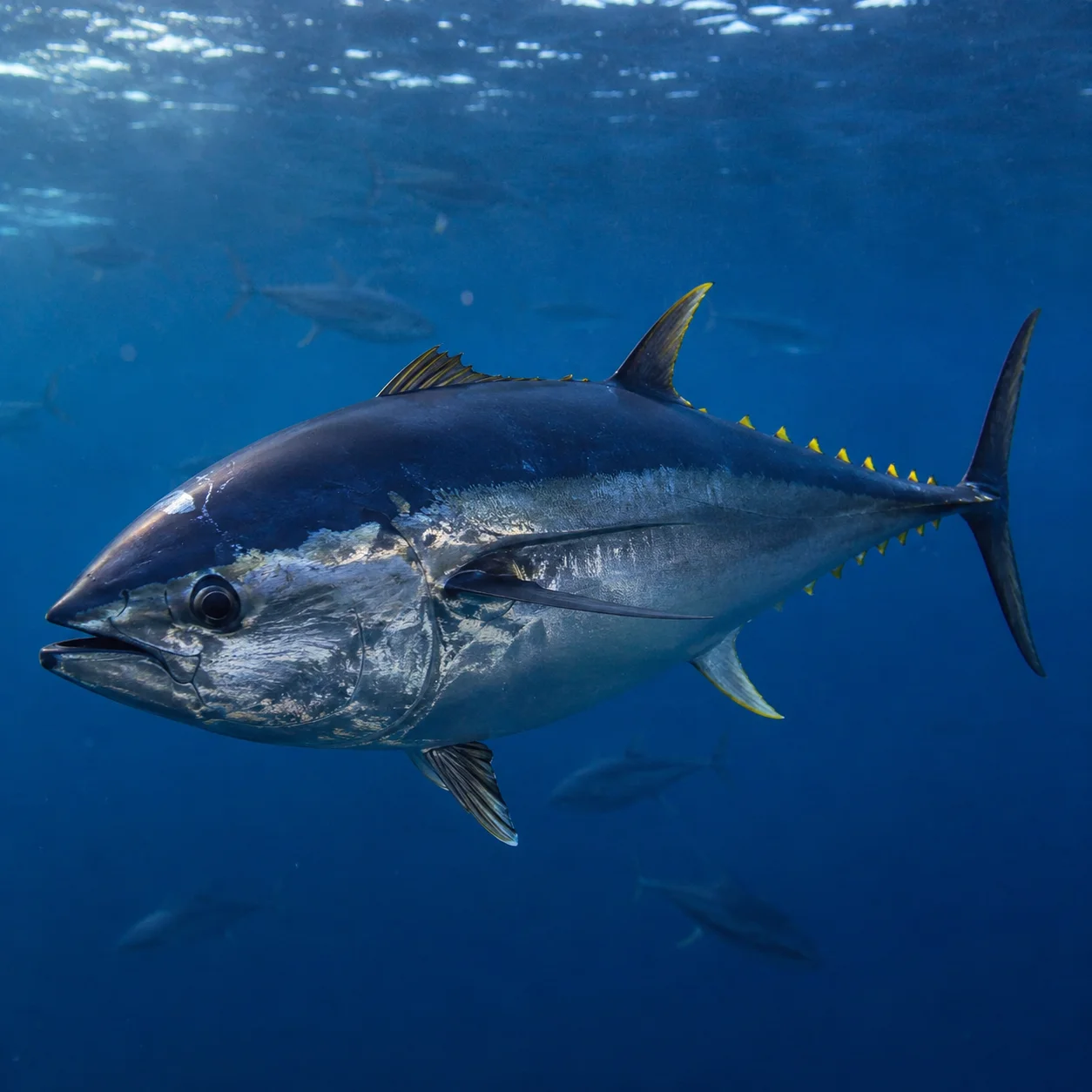
Bluefin tuna belongs to that rare category of fish that immediately shifts the scale of the sea. More pelagic than coastal, more mobile than almost every other species in the usual line-up, it demands a different way of reading the environment: one built around large water masses, thermal fronts and offshore migrations rather than holding spots or drop-offs. To place it among the other species tracked on the Atlantic coast, you can also check our page on Atlantic fish species.
Quick facts on bluefin tuna
Where to look: thermal fronts, water mass edges, convergence zones and sectors where anchovy, sardine and horse mackerel concentrate, offshore in the Bay of Biscay — typically between 40 and 500 m of depth, at least 15 km from the coast.
When to look: mainly June to October, with the clearest window in August-September.
Favourable temperature: around 17 to 22 °C, with a wider tolerance of 10 to 26 °C.
Main food: anchovy, sardine, horse mackerel and other schooling fish, as well as cephalopods.
Technique covered on this page: lure fishing on feeding frenzies — spotting surface bait balls, approaching by boat, casting a popper or soft lure.
Signals to watch for: diving birds, splashes, panicked baitfish at the surface, boiling water.
Bluefin tuna, a major pelagic predator well established in the Atlantic
Atlantic bluefin tuna (Thunnus thynnus) is one of the largest pelagic predators of the North Atlantic and adjacent seas. It's an oceanic fish that can seasonally move close to shore, living in shoals of similarly sized individuals, with considerable longevity and an exceptional size. It can reach spectacular dimensions: up to around 3.3 m and 725 kg according to European reviews, which alone shows the species' very particular status.
But what really sets bluefin tuna apart isn't just its power: it's its relationship with space. Where seabass reads the coastline and meagre reads the estuary, bluefin tuna reads the living Atlantic — water masses, thermal fronts, productivity edges and prey concentrations. It's an extremely mobile fish, capable of migrations of several thousand kilometres across the North Atlantic basin, moving back and forth between feeding grounds and spawning grounds.
In the Bay of Biscay, this dimension becomes very concrete for anglers. Bluefin tuna isn't a year-round presence there, but a strong seasonal one, tied to summer and autumn dynamics, baitfish and surface structures that make the sea easier to read.
| Element | Data |
|---|---|
| Common name | Atlantic bluefin tuna |
| Scientific name | Thunnus thynnus |
| Family | Scombridae |
| Species type | Large migratory pelagic predator |
| Maximum size | Up to around 3.3 m according to European reviews |
| Maximum weight cited | Up to around 725 kg |
| Depths frequented | Near surface to great depths, frequent dives between 500 and 1000 m |
| Distribution | North Atlantic, Mediterranean, adjacent seas |
| Lifestyle | Shoals of similarly sized individuals, long-range movements |
| Most favourable period (Bay of Biscay) | June to October |
What does bluefin tuna eat? Understanding its prey to locate it better
Bluefin tuna follows life above all else. Its diet is dominated by small schooling fish and cephalopods, with a strong dependence on regional opportunities. In the Bay of Biscay, the idea of bluefin tuna following anchovy, sardine and horse mackerel along edges and productive zones is entirely credible.
Bluefin tuna's main prey
- anchovy,
- sardine,
- horse mackerel,
- other schooling baitfish,
- cephalopods (squid, cuttlefish).
Where baitfish fall into order, bluefin tuna become thinkable. It's the combination of three elements that makes the species readable: a visible front, credible bait, and a coherent seasonal window.
| Dominant prey | Likely area | Useful reading |
|---|---|---|
| Anchovy, sardine | Water mass edges, thermal fronts, convergence zones | Watch for birds, splashes and surface baitfish concentrations |
| Horse mackerel | Stratified zones, deeper offshore sectors | Look for boiling water and surface activity above shoals |
| Cephalopods | Wider productive zones, oceanic sectors | Less visible at the surface, often alongside active feeding |
How to fish bluefin tuna on feeding frenzies?
In the Bay of Biscay, lure fishing for bluefin tuna is practised almost exclusively on feeding frenzies: the fish is spotted at the surface attacking a bait ball, before being approached and cast to. This page covers only that technique.
Spotting the frenzy
Signals to watch for are diving birds (notably gannets), surface splashes, panicked baitfish and boiling water — areas where the sea seems to literally boil under the force of the attacks. A pair of binoculars and constant attention to the horizon are essential to spot a frenzy before it moves on.
Approaching and positioning
The priority is to position yourself on the right side of the frenzy: boat placed ahead of the action and angled with the wind at your back, to allow an effective cast without spooking the fish. An approach that's too direct or too noisy often pushes the shoal down before the first cast is even made.
Working the lure according to the intensity of the frenzy
On a large frenzy in full boil, the fish's frenzy and aggression are such that most lures stand a chance of being taken — in that case it's better to favour inexpensive soft lures, since the risk of a cut line is high in these conditions. On a smaller, more discreet frenzy, a popper is often the best first cast; you can switch to a soft lure once the activity settles. When a frenzy has just ended, a loud popper can sometimes reignite the attack and bring the fish back up.
With a popper, the retrieve involves working the lure ahead of the frenzy and, where possible, pausing when the moving frenzy crosses the lure's path: the strike often comes as you resume the retrieve after that pause. With a soft lure, let it sink before the frenzy arrives, then use a steady retrieve once it's close.
Managing the fight
Bluefin tuna forces a physical fight, sometimes a long one, with powerful runs. Tackle genuinely sized for the species (see below) and careful drag management are essential to bring the fish in within a reasonable time, especially with catch-and-release in mind.
| Situation | What to do |
|---|---|
| Frenzy spotted in the distance | Approach from ahead, wind at your back, without charging straight at it |
| Large frenzy in full boil | Quickly cast an inexpensive soft lure or a popper, expect solid hits |
| Small, discreet frenzy | Popper on the first cast, switch to soft lure if activity drops |
| Frenzy that has just ended | Loud popper to try to bring the fish back up |
| Fish hooked | Controlled fight, managed drag, tackle sized for the species |
What lures and tackle to use on a frenzy?
Lure choice mainly depends on the intensity of the frenzy. On large frenzies, soft lures like the Crazy Sand Eel (Fiiish), the Nitro Shad 120 mm (Illex) or the Black Minnow (Fiiish) give good results, backed up by poppers. On smaller, more discreet frenzies, the popper remains the priority choice. When a frenzy has just ended, loud rattling poppers, such as the Feed Popper (Tackle House) in 150 or 175 mm DW version, can reignite the attack. To bring fish up from depth, wooden poppers like the Strike Pro Tuna Hunter have proven effective.
For soft lures, reinforced jig heads are essential to withstand the fish's power — for example a VD Slim (35 to 95 g depending on weight) or an X-Strong model from Fiiish.
| Situation | Suitable lures |
|---|---|
| Large frenzy / boiling water | Inexpensive soft lures (Crazy Sand Eel, Nitro Shad 120mm, Black Minnow), poppers |
| Small, discreet frenzy | Popper first, then soft lure if activity settles |
| Frenzy ended | Loud popper (Feed Popper 150/175mm DW) |
| Bringing fish up | Wooden popper (Strike Pro Tuna Hunter) |
Tackle: sizing that shouldn't be overlooked
Bluefin tuna calls for specific tackle, very different from what's used for other species in the usual line-up. A rod of 2.20 to 2.40 m, with a power rating of at least 100 lb (up to 130-200 lb depending on setup), able to cast lures of 60 to 175 g, is needed to absorb the fish's power while keeping enough casting distance to reach the frenzy.
For the reel, aim for a large size (in the region of 14000 to 30000 depending on the rod's power), a quality carbon drag and a minimum capacity of 300 m of braid. The braid itself should be PE 8 to PE 12 (120 to 150 lb), 8 or 12 strand, for both strength and casting distance.
| Element | Guideline |
|---|---|
| Rod | 2.20 to 2.40 m, minimum 100 lb power rating, casting weight 60 to 175 g |
| Reel | Size 14000 to 30000, carbon drag, minimum 300 m braid capacity |
| Braid | PE 8 to PE 12 (120 to 150 lb), 8 or 12 strand |
| Soft lure rig | Reinforced jig head required (X-Strong type) |
Where does bluefin tuna live on the Atlantic coast?
Bluefin tuna occupies the whole of the North Atlantic pelagic zone and its adjacent seas. It lives near the surface in temperate waters, but also dives very deep, with frequent dives between 500 and 1000 m. This vertical range shouldn't blur the fishing picture, though: in the Bay of Biscay, when fishing frenzies, bluefin tuna becomes especially interesting when it's using the upper layers and sectors where food concentrates at the surface.
For bluefin tuna, the central question isn't therefore "which spot?", but rather: where does the sea start organising life? It's this nuance that changes the whole way of thinking about its presence.
In the FishPredict model, bluefin tuna is sought between 40 and 500 m of depth and at least 15 km from the coast — consistent with its pelagic nature and its offshore presence rather than right along the shore. Don't expect to see favourable areas close to the shoreline: the reading is firmly offshore.
| Type of sector | Potential interest for bluefin tuna |
|---|---|
| Mesoscale thermal front | Readable break, circulation, concentrated prey |
| Water mass edge | Favourable edge for baitfish grouping |
| Convergence zone | Surface organisation, trophic activity |
| Coast-to-offshore transition | Passage between coastal productivity and open ocean |
| Sector followed by anchovy, sardine, horse mackerel | Credible food resource |
| Living stratified zone | Clearer reading of favourable layers |
What is the best season for bluefin tuna in the Bay of Biscay?
On the thermal side, the window of 17 to 22 °C as the optimal zone, with a wider tolerance of 10 to 26 °C, fits well with the warm-temperate nature of a summer and autumn presence in the bay. Bluefin tuna isn't just "tolerant": it becomes especially more consistent to follow when temperature, stratification and biological production line up.
| Period | General reading |
|---|---|
| Winter | Presence not readable for ordinary coastal fishing purposes |
| Spring | Still a fairly inconsistent period in the Bay of Biscay |
| June | Start of the window, gradual return depending on the year |
| July | Reading window confirming itself |
| August | Strong period on fronts and productive zones |
| September | Excellent readability depending on baitfish and water structures |
| October | End of the favourable window, still possible depending on conditions; administrative closure generally around 15 October |
This table doesn't mean the fish "doesn't exist" outside this period: it simply means that, for an angler in the Bay of Biscay, the genuinely useful window is concentrated in these months.
Migration and biology of bluefin tuna: understanding its cycle
The species' broader biology plays out at basin scale. The main spawning grounds are classically associated with the Mediterranean and the Gulf of Mexico, while the Bay of Biscay mainly plays the role of a feeding ground and seasonal passage. It's this difference that makes the species so particular: it doesn't become interesting because of local rootedness, but because of a seasonal return of the living ocean.
Bluefin tuna changes the way you look at the Atlantic. It forces you to move away from fishing thought of in terms of spots and micro-zones, into a reading of large structured spaces: the waterline, the thermal edge, the concentration of baitfish, the coherence of a water mass and the logic of a movement.
What makes an area truly interesting for bluefin tuna
Bluefin tuna becomes especially interesting to target when several factors combine. The first is temperature: conditions are generally more favourable around 17 to 22 °C, with a wider tolerance of 10 to 26 °C. The second factor is the presence of a readable thermal front or water mass edge, which structures the space and concentrates prey. The third is the presence of baitfish — anchovy, sardine, horse mackerel — visible at the surface through bird activity and splashes, backed by a sufficient level of zooplankton to sustain the whole food chain.
In practice, an area favourable to bluefin tuna often brings together three elements: a readable front, credible bait and a coherent seasonal window. When these three dimensions come together, the species stops being an oceanic abstraction and becomes a fish you can follow methodically.
| Factor | Useful guideline for bluefin tuna |
|---|---|
| Water temperature | Around 17 to 22 °C, tolerance 10 to 26 °C |
| Thermal front / water mass edge | Readable surface break, often linked to hunting activity |
| Baitfish | Anchovy, sardine, horse mackerel — presence signalled by birds and splashes |
| Zooplankton | Model index around 2 to 15 |
| Depth / distance from coast | 40 to 500 m, from 15 km offshore |
| Seasonal window | June to October, peaking in August-September |
Bluefin tuna regulations in France: permit, quota and tagging
Check before every trip
Recreational bluefin tuna fishing is strictly regulated in France and checks are frequent. This section describes the French regulations, which apply in the Bay of Biscay. An annual administrative permit is required per boat, to be requested from the regional maritime authority (DIRM) covering the home port — for the New Aquitaine coast, this is the DIRM Sud-Atlantique. Two regimes exist: a permit allowing catch-and-release only, and a permit allowing capture and landing. A single permit per boat covers everyone on board.
In 2026, the French national quota stands at 7,833 tonnes, of which only 78.3 tonnes are allocated to recreational fishing — a small share that explains the strictness of the system. Any fish kept must be tagged immediately after capture to track catches within the collective quota, and reporting applies even to released fish. Selling a fish caught while recreational fishing is strictly prohibited. The administrative closure generally falls around 15 October.
If you fish bluefin tuna outside France, note that other countries run their own permit and quota systems under the same ICCAT international framework — always check the rules that apply where you're fishing.
⚠️ Important: minimum sizes, quotas per trip and precise arrangements change every year by ministerial order (in France) or equivalent regulation elsewhere. Before any trip, check the exact conditions for the current season and submit your permit request directly to the relevant authority.
FAQ on bluefin tuna
Is bluefin tuna an Atlantic fish?
Yes. Thunnus thynnus occupies the whole North Atlantic and its adjacent seas, including the Mediterranean.
At what depth does bluefin tuna live?
It lives near the surface but can also dive very deep, with frequent dives between 500 and 1000 m.
When do you see bluefin tuna in the Bay of Biscay?
The most readable window is mainly between June and October, peaking in August-September.
What does bluefin tuna eat?
Small schooling fish such as anchovy, sardine and horse mackerel, as well as cephalopods.
Is bluefin tuna only fished on feeding frenzies?
On this page, yes: it only covers lure fishing on feeding frenzies, the most widely practised technique in the Bay of Biscay, which involves spotting a shoal at the surface before approaching and casting a lure.
Do you need a permit to fish bluefin tuna?
In France, yes, an annual administrative permit per boat is required from the DIRM covering the home port. Rules differ in other countries — always check locally.
Can you sell a bluefin tuna caught while recreational fishing?
No. Recreational bluefin tuna fishing is strictly non-commercial.


